Table of contents
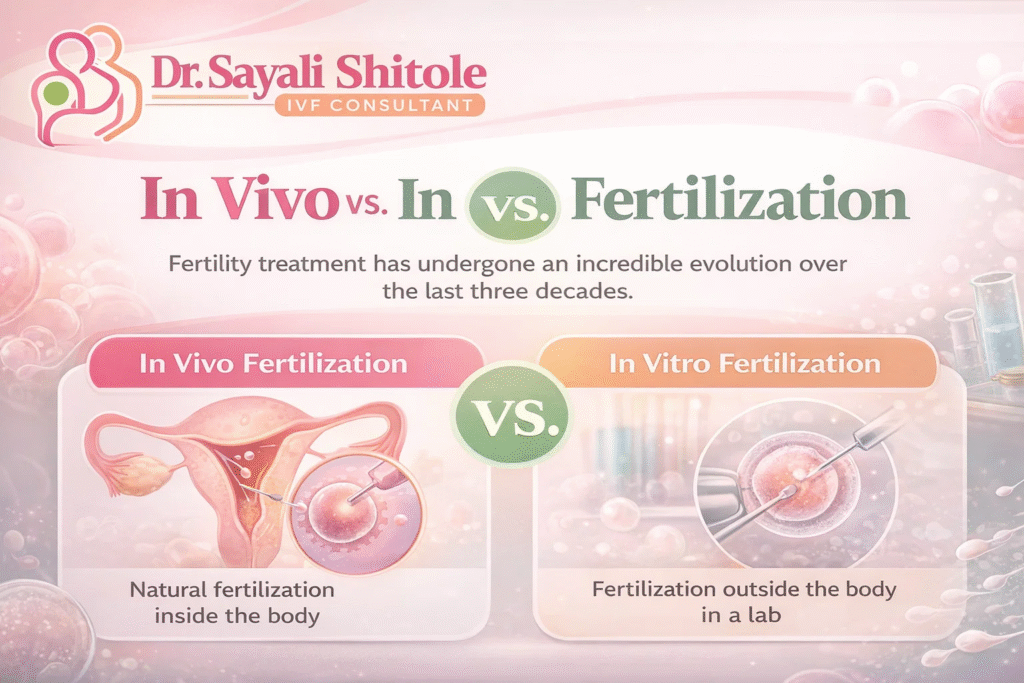
Fertility treatment has undergone an incredible evolution over the last three decades. While couples once faced limited options for treating infertility, modern reproductive medicine now provides couples with tailored solutions tailored specifically for them. One key concept on any fertility journey should be in vitro fertilization vs in vivo fertilization: both offer different processes, candidates, and outcomes when trying for pregnancy.
No matter where your fertility journey may lead you, understanding its scientific basis will give you greater confidence when making treatment decisions.
What Is In Vivo Fertilization?
In Latin, in vivo means “within living things.” Thus, In Vivo Fertilization refers to any process which occurs inside an organism such as within its fallopian tubes where an egg and sperm meet during in vitro fertilization and join forces.
Everyday pregnancies typically unfold as follows: the woman produces an egg during ovulation, and sperm travel through her reproductive tract before fertilization happens naturally within her body. However, medically assisted in-vitro techniques may significantly improve chances for couples facing mild fertility challenges;
- Intrauterine Insemination (IUI): Washable and concentrated sperm are placed directly into the uterus at or shortly before ovulation to increase its chances of natural fertilization and decrease travel distance for fertilized eggs to reach fertilisation sites.
- Ovulation Induce: Hormonal medications help the ovaries produce one or more mature eggs, increasing both its timing and likelihood of successful fertilization.
- Timed Intercourse: Monitoring ovulation with ultrasounds and hormone testing allows couples to time intercourse for maximum effectiveness.
In-vivo approaches are generally seen as the initial line of treatment – they’re lower cost, less physically taxing, and ideal for couples struggling with mild infertility or inexplicable infertility.
What Is In Vitro Fertilization (IVF)?
“In vitro” refers to fertilization occurring outside of a woman’s uterus in a laboratory environment. With IVF, eggs are removed from ovaries and fertilized by sperm outside her body in an incubator setting before being transferred back. The embryo then undergoes intensive monitoring before being implanted back into her uterus for continued development.
IVF is the most frequently employed and successful form of assisted reproductive technology (ART) available today, consisting of five stages that typically follow each other:
- Ovarian Stimulation: Hormonal injections promote multiple mature egg production in order to increase the number of viable embryos available for fertilization.
- Egg Retrieval: Under sedation, minimally invasive procedures collect mature eggs from ovarian follicles in order to harvest viable embryos for future development.
- Fertilization in the Lab: Eggs and sperm are combined in a laboratory dish for in vitro fertilization. In cases of severe male factor infertility, an individual sperm may be injected directly into an egg using Intracytoplasmic Sperm Injection (ICSI).
Embryo Culture and Monitoring: Fertilized embryos are monitored over three to five days as they develop, enabling embryologists to select only healthy candidates. Embryo Transfer: After embryo selection has taken place, one or more selected embryos may be transferred directly into the uterus for implantation and pregnancy to occur.
IVF should be considered for patients facing more complex fertility challenges, such as blocked or damaged fallopian tubes, severe male factor infertility, advanced maternal age, endometriosis, repeated pregnancy loss or failed IUI cycles.
In Vivo vs. In Vitro: Side-by-Side Comparison
| Feature | In Vivo Fertilization | In Vitro Fertilization (IVF) |
| Fertilization Site | Inside the body (fallopian tubes/uterus) | Outside the body (fertility lab) |
| Process Type | Natural or minimally assisted | Medically controlled & assisted |
| Invasiveness | Low to moderate | Moderate (requires egg retrieval) |
| Ideal Candidate | Mild fertility challenges | Moderate to severe infertility |
| Success Rate / Cycle | Lower (IUI ~15–20%) | Higher (IVF ~40–50% in younger patients) |
| Customization | Limited | High — ICSI, PGT, FET available |
| Cost | Lower | Higher (but better outcomes for complex cases) |
Which Treatment Is Right for You?
The answer depends on several individual factors, including the underlying cause of infertility, the woman’s age, the quality of sperm, previous treatment history, and overall reproductive health. A thorough diagnostic evaluation — including hormonal blood tests, semen analysis, transvaginal ultrasound, and uterine assessments — should always precede any treatment recommendation.
As a general guide:
- Couples with mild, unexplained infertility or ovulatory disorders may benefit from IUI or timed intercourse first.
- Patients with structural issues, severe male factor infertility, or multiple failed IUI cycles are typically better served by IVF.
- Women over 35 often have better outcomes with IVF due to higher per-cycle success rates and greater control over embryo quality.
- Couples with inheritable genetic conditions may benefit from IVF combined with Preimplantation Genetic Testing (PGT) to screen embryos before transfer.
No two fertility journeys are identical. The most important step is a personalized consultation with an experienced reproductive specialist who can assess your complete clinical picture and guide you toward the most effective and appropriate treatment path.
🔑 Key Takeaways
- In vivo fertilization occurs inside the body; in vitro fertilization occurs in a controlled laboratory environment outside the body.
- IUI and timed intercourse are common medically assisted in vivo approaches — lower cost and less invasive, suited to mild infertility.
- IVF is recommended for moderate-to-severe fertility challenges and offers higher per-cycle success rates than IUI.
- ICSI, PGT, and frozen embryo transfers are advanced tools available within the IVF process, offering greater precision and personalization.
- A specialist evaluation is essential before choosing between in vivo and in vitro treatments.
- Age plays a significant role — IVF success rates are highest in women under 35 but can be effective at any age with proper clinical guidance.
- Kalyani Nagar, Pune is home to expert fertility care; consult Dr. Sayali Shitole Chavan for a personalized fertility assessment.
Consult a Trusted IVF Specialist in Pune — Kalyani Nagar
If you are on your fertility journey in Pune, Dr. Sayali Shitole Chavan — widely regarded as a leading IVF Specialist in Pune — brings over a decade of expertise in reproductive medicine to the heart of Kalyani Nagar. Her patient-first philosophy, combined with advanced reproductive technologies and personalized treatment protocols, ensures that every couple receives the care and attention they deserve. Whether you require IUI, IVF, ICSI, or genetic embryo screening, Dr. Sayali and her team are equipped to guide you every step of the way.
📞 Book Your Consultation Today!

Dr. Sayali Chavan - Shitole
Dr. Sayali Shitole Best IVF & Fertility Specialist in Pune is a reliable and among the Best IVF Clinic in Pune & IVF Centre in Pune. Dr. Sayali Shitole is equipped with all ultra-modern facilities IVF Clinic/IVF Centre and Test Tube Baby Centre in Pune.