| Key Takeaways PCOS is the most common cause of anovulatory infertility, affecting 10-15% of Indian women of reproductive age.Lifestyle modification and metformin are the first treatment steps, improving ovulation in 40-60% of PCOS patients.Letrozole is now the preferred first-line medication for ovulation induction in PCOS, replacing clomiphene.According to ICMR, women with PCOS who need IVF require a modified protocol to reduce OHSS risk.A freeze-all IVF strategy significantly reduces OHSS severity in high-risk PCOS patients.PCOS does not permanently prevent pregnancy. Most women with PCOS who receive treatment do conceive.Both AMH and antral follicle count are typically elevated in PCOS, reflecting the high egg reserve. |
| Quick Facts PCOS prevalence in Indian women: 10-15% of reproductive-age women Anovulation in PCOS: 70-80% of women with PCOS Letrozole ovulation rate in PCOS: 70-80% per cycle PCOS IVF success rate under 35: 45-55% per cycle OHSS risk in PCOS IVF: Elevated, managed with protocol modification Time to conception with treatment: 3-12 months for most PCOS patients |
PCOS infertility treatment Pune 2026
| Metric | Data Point | Source |
| PCOS prevalence India | 10-15% of reproductive-age women | ICMR 2024 |
| PCOS as cause of anovulatory infertility | 70-75% of anovulation cases | WHO 2022 |
| Letrozole ovulation rate in PCOS | 70-80% | PubMed 2022 |
| Cumulative pregnancy rate OI 3 cycles | 30-40% | Industry estimate |
| IVF success PCOS under 35 | 45-55% per cycle | ICMR 2024 |
| OHSS risk in PCOS IVF | Higher, managed with freeze-all | ICMR 2024 |
| Metformin improving ovulation in PCOS | Effective in insulin-resistant cases | Indian J Medical Research |
Understanding PCOS and Why It Affects Fertility
Polycystic ovary syndrome (PCOS) is a hormonal disorder where the ovaries produce excess androgens (male hormones) and develop multiple small follicles that don’t mature into dominant eggs. Without a dominant follicle, ovulation doesn’t occur. No ovulation means no egg available for fertilisation. This anovulatory state is why PCOS is the most common cause of irregular periods and ovulation-related infertility.
The word ‘polycystic’ is a misnomer. The small follicles seen on ultrasound are not cysts. They are immature eggs arrested at an early stage of development. Women with PCOS typically have elevated AMH levels and high antral follicle counts on ultrasound, confirming the large pool of immature follicles. This high egg reserve is actually an advantage when it comes to IVF.
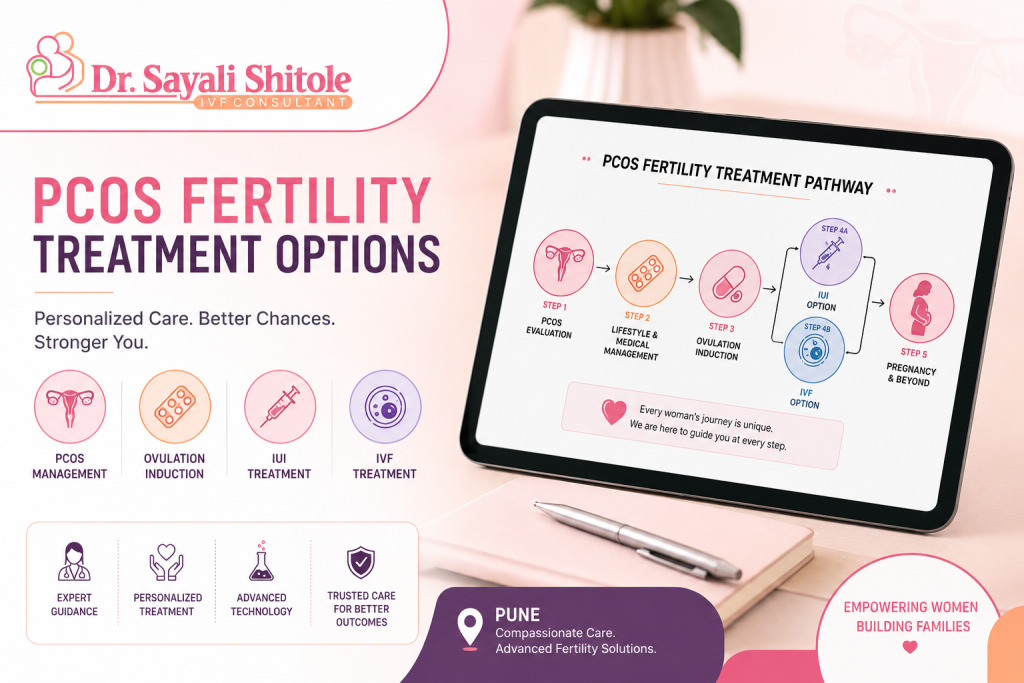
PCOS Infertility Treatment: The Step-by-Step Approach
| Step | Treatment | Duration | Cost Pune (INR) | Expected Outcome |
| Step 1 | Lifestyle: diet, exercise, weight loss if BMI above 25 | 3 months minimum | Minimal cost | Restores ovulation in 40-60% with 5-10% weight loss |
| Step 2 | Metformin (if insulin resistant) | 3-6 months | 500 to 1,500/month | Improves insulin sensitivity, regularises cycles |
| Step 3 | Ovulation induction with letrozole | Per cycle | 300 to 800 per cycle | 70-80% ovulation rate, 10-20% pregnancy per cycle |
| Step 4 | IUI with ovulation induction | Per cycle | 8,000 to 20,000 | 15-25% pregnancy per cycle |
| Step 5 | IVF with PCOS protocol | Per cycle | 1.4L to 2.2L | 45-55% under 35 with freeze-all strategy |
Why Lifestyle Changes Are the First Step for PCOS Fertility
Insulin resistance is present in 70-80% of overweight women with PCOS and in 20-30% of lean women with PCOS. When cells are resistant to insulin, the pancreas overproduces it. Excess insulin stimulates the ovaries to produce more androgens, worsening the hormonal imbalance. Reducing insulin resistance through diet, exercise and weight loss breaks this cycle.
Even a 5-10% reduction in body weight restores ovulation in 40-60% of PCOS women who were previously anovulatory. This is a profound result that requires no medication. For Pune’s sedentary IT workforce, building daily walking (30 minutes), reducing refined carbohydrates and adding strength training twice a week can genuinely change the hormonal environment.
IVF for PCOS: The Freeze-All Strategy
Women with PCOS who need IVF have a specific risk that changes the standard approach: Ovarian Hyperstimulation Syndrome (OHSS). PCOS ovaries respond excessively to gonadotropin stimulation, producing many eggs (sometimes 20-30 in a single cycle). If a fresh embryo transfer is done in the same stimulation cycle, the high oestrogen environment worsens OHSS.
The solution is a freeze-all strategy: all good quality embryos are vitrified in the stimulation cycle, OHSS is allowed to resolve naturally over 2-4 weeks and a frozen embryo transfer is done in a subsequent unstimulated cycle. This approach preserves the embryos and the endometrium and significantly reduces severe OHSS risk without compromising pregnancy rates.
At Femcare Fertility in Kalyani Nagar, Dr. Sayali Shitole Chavan routinely uses freeze-all strategies for PCOS patients at high OHSS risk. This is standard protocol at well-equipped Pune fertility centres in 2026.
PCOS Infertility Care in Pune: Local Perspective
PCOS is extremely common in Pune, affecting women across all areas from Pimpri Chinchwad and Hinjewadi to Koregaon Park and Kothrud. The combination of sedentary IT work, processed food and high stress creates a perfect environment for insulin resistance to develop. Many Pune women are diagnosed with PCOS in their teens or early 20s but don’t seek fertility treatment until their late 20s or 30s.
Metformin, letrozole and IUI for PCOS are widely available at gynaecology clinics across Pune. For IVF with a specific PCOS protocol, a dedicated fertility centre with OHSS monitoring capability is essential. Femcare Fertility in Kalyani Nagar has the monitoring infrastructure and clinical expertise to manage PCOS IVF safely.
Frequently Asked Questions
Q: Can I get pregnant naturally with PCOS?
Yes, many women with PCOS conceive naturally, particularly those with irregular rather than absent ovulation. Lifestyle optimisation restores ovulation in a significant proportion. For women who don’t ovulate at all, medical treatment is needed. PCOS does not make pregnancy impossible. It makes it harder without the right support.
Q: Is letrozole or clomiphene better for PCOS?
Current ICMR and international guidelines recommend letrozole as the first-line ovulation induction agent for PCOS. Multiple clinical trials including PPCOS II showed higher live birth rates with letrozole than clomiphene. Letrozole also has fewer anti-oestrogenic effects on the endometrial lining.
Q: Does PCOS affect IVF success rates?
Women with PCOS generally have good IVF success rates (45-55% per cycle under 35) because their high egg reserve means many eggs are collected per stimulation cycle. The main challenge is OHSS risk, which is managed with a freeze-all strategy. Overall, PCOS is one of the more treatable causes of infertility when the right protocols are used.
Q: I have PCOS and a BMI of 29. Should I lose weight before fertility treatment?
A BMI above 25-27 reduces ovulation response to medications and lowers IVF success rates in PCOS. Even a 5-10% weight reduction (about 5-8 kg for a 70 kg woman) measurably improves hormonal profiles and stimulation response. Three months of weight-focused lifestyle changes before treatment is often clinically recommended. Your doctor will advise based on your specific BMI and urgency.
Q: What is the PCOS IVF success rate in Pune?
For women under 35 with PCOS undergoing IVF at well-equipped Pune fertility centres, success rates of 45-55% per cycle are reported. The freeze-all strategy used in PCOS patients achieves similar or slightly better success rates than fresh transfers while significantly reducing OHSS risk.
Conclusion
PCOS infertility treatment in Pune 2026 follows a clear, evidence-based pathway. From lifestyle and metformin to ovulation induction, IUI and IVF with PCOS-specific protocols, every step is designed to restore ovulation while managing the specific risks of PCOS. Most women with PCOS who receive appropriate treatment do achieve pregnancy.
Dr. Sayali Shitole Chavan at Femcare Fertility, Kalyani Nagar, has extensive experience managing PCOS-related infertility. Her individualised approach addresses both the metabolic and reproductive aspects of PCOS simultaneously, improving the chance of success at every treatment step.

Dr. Sayali Chavan - Shitole
Dr. Sayali Shitole IVF & Fertility Specialist in Pune is a reliable and among the IVF Clinic in Pune & IVF Centre in Pune. Dr. Sayali Shitole is equipped with all ultra-modern facilities IVF Clinic/IVF Centre and Test Tube Baby Centre in Pune.