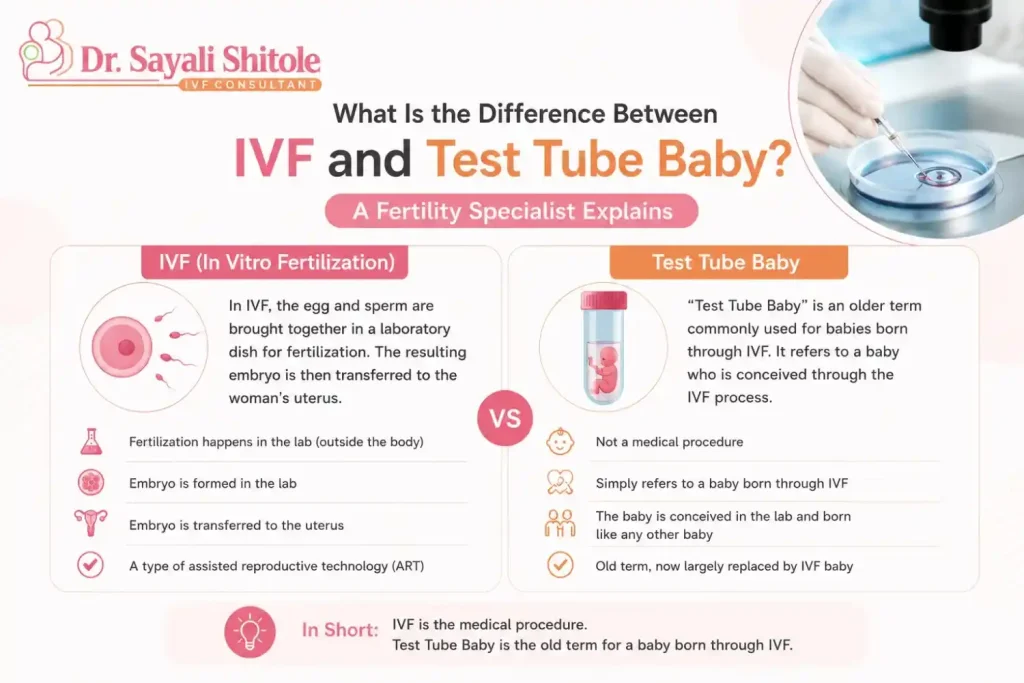
There is no medical difference between IVF and a test tube baby. Both terms describe the same procedure: fertilisation of an egg and sperm outside the human body in a laboratory. Test tube baby is a popular term coined in 1978 when the technology was first introduced. IVF is the correct clinical term used by doctors worldwide today.
If you have been researching fertility treatment in Pune, you have almost certainly come across both terms — IVF and test tube baby. And if you have wondered what is the difference between IVF and test tube baby, you are asking a question that many couples ask during their first consultation.
The honest answer is that there is no difference. IVF and test tube baby refer to exactly the same medical procedure. The confusion is understandable because the two terms have different origins, different associations, and different emotional weight. This guide explains where each term comes from, how the procedure works, and why understanding this matters when you are choosing a fertility clinic in Pune.
Dr. Sayali Chavan Shitole is a fellowship-trained IVF specialist practising at Femcare Fertility in Kalyani Nagar, Pune. She has helped hundreds of couples understand their fertility options clearly and honestly. More about her practice is available at Femcare Fertility in pune
Where Did the Term “Test Tube Baby” Come From?
On 25 July 1978, Louise Brown was born in Oldham, England — the first human being conceived outside the human body. The media immediately described her as a “test tube baby,” a phrase that captured the imagination of the world and has never fully disappeared from public conversation.
The term was always informal. No doctor or embryologist actually uses a test tube to fertilise eggs. The process takes place in a sterile laboratory dish — a petri dish — using precise temperature, humidity, and gas environment controls. The word “test tube” was a simplification for public understanding, chosen at a time when most people had no frame of reference for laboratory reproduction.
Forty-seven years later, the term test tube baby persists in India, South Asia, and much of the developing world because it entered popular language before the clinical term IVF became widely known. Grandparents, neighbours, and well-meaning relatives still use it. Patients searching online still type it. That is why both terms appear side by side on fertility clinic websites — because the audience uses both.
What Does IVF Actually Mean?
IVF stands for In Vitro Fertilisation. In Latin, in vitro means “in glass” — referring to the laboratory vessel in which fertilisation occurs outside the body. In vivo, by contrast, means “in the living body,” which is how conception occurs naturally.
IVF is the globally accepted clinical term. Every fertility textbook, research paper, hospital protocol, and regulatory body in the world uses IVF. When Indian doctors, embryologists, and fertility specialists discuss the procedure among themselves or in academic settings, they always use IVF — never test tube baby.
So when someone asks what is the difference between IVF and test tube baby, the complete and accurate answer is: one is the clinical term, the other is the popular term. They describe the same procedure from start to finish.
IVF vs Test Tube Baby: Side-by-Side Comparison
The table below shows exactly how the two terms compare across every dimension.
| Parameter | IVF (In Vitro Fertilisation) | Test Tube Baby |
| Full form | In Vitro Fertilisation | Informal popular term (no full form) |
| Origin | Medical/scientific terminology | Media term coined in 1978 |
| Medical procedure | Same procedure | Same procedure |
| Where used | Clinics, hospitals, research, globally | Common in India and South Asia |
| First used | 1978 (clinical journals) | 1978 (newspaper headlines) |
| Accuracy | Precise and clinically correct | Imprecise but widely understood |
| Lab vessel used | Petri dish or culture dish | Not actually a test tube |
| Outcome | Baby born after uterine transfer | Same outcome |
| Variants | IVF-ICSI, FET, donor IVF, etc. | No clinical variants |
How the IVF Procedure Works — Step by Step
Whether a couple calls it IVF or a test tube baby procedure, the medical process is identical. Here is how it works at a fertility clinic like Femcare Fertility in Kalyani Nagar, Pune.
Step 1: Initial Consultation and Diagnosis
The couple meets the fertility specialist for a detailed workup. This includes a hormonal blood panel for the woman (AMH, FSH, LH, TSH, prolactin), an antral follicle count via ultrasound, and a semen analysis for the male partner. The diagnosis determines which IVF protocol is most appropriate.
Step 2: Ovarian Stimulation
The woman receives daily hormone injections for eight to twelve days to stimulate the ovaries to produce multiple mature eggs. During this period, the doctor monitors follicle growth through regular ultrasound scans and adjusts medication doses accordingly. This monitoring phase is critical and should always be supervised personally by the treating specialist.
Step 3: Egg Retrieval (Ovum Pick-Up)
When the follicles reach the correct size, a trigger injection is given. Approximately 36 hours later, the eggs are retrieved under sedation using a thin needle guided by ultrasound. The procedure takes around 20 to 30 minutes and the patient goes home the same day.
Step 4: Fertilisation in the Laboratory
This is the step that gave rise to the term test tube baby. The retrieved eggs and the prepared sperm sample are placed together in a laboratory dish in a controlled incubator environment. Fertilisation occurs over the next 16 to 20 hours. In cases where sperm quality is poor, a single sperm is injected directly into each egg — a technique called ICSI (Intracytoplasmic Sperm Injection).
Step 5: Embryo Culture and Development
The fertilised eggs develop into embryos over three to five days. The embryologist assesses embryo quality at each stage. By day five, the best-quality embryos reach the blastocyst stage — the developmental point at which implantation rates are highest.
Step 6: Embryo Transfer
One or two embryos are selected and transferred into the woman’s uterus using a thin, flexible catheter. The procedure is painless and requires no anaesthesia. Additional embryos of good quality are frozen for future use in a process called vitrification.
Step 7: Pregnancy Test
Fourteen days after the embryo transfer, a blood test (serum beta-hCG) confirms whether implantation has occurred. A positive result marks the beginning of the pregnancy. The fertility specialist then monitors the early weeks before transitioning care to an obstetrician.
Is There Any Difference in Success Rates?
No. Because IVF and test tube baby are the same procedure, there is no difference in success rates between them. The phrase you use to describe the treatment has no bearing on the outcome.
What does affect success rates is the quality of the fertility clinic, the experience of the specialist, the standard of the embryology laboratory, and factors specific to the couple — primarily the woman’s age and the ovarian reserve (AMH level).
Industry estimate: IVF success rates in India for women under 35 with good ovarian reserve typically range from 50 to 65% per embryo transfer cycle at well-equipped fertility centres.
Age is the single most important biological variable. A woman at 28 has a meaningfully higher success rate per cycle than a woman at 40, because egg quality declines with age. This is why early diagnosis and timely intervention matter.
Common Questions Patients Ask at Femcare Fertility, Pune
1. Is a test tube baby healthy?
Yes. Decades of global data confirm that children born through IVF are as healthy as children conceived naturally. Studies following IVF-conceived individuals into adulthood show no significant difference in physical health, cognitive development, or reproductive function. Industry estimate, based on published reproductive medicine literature.
2. Is the baby kept in a test tube?
No. The baby is not kept in a test tube at any point. The embryo develops in a temperature-controlled laboratory incubator for three to five days before being transferred into the mother’s uterus. From that point onward, pregnancy and delivery proceed exactly as they would after natural conception.
3. Is IVF the only option for couples who cannot conceive?
Not necessarily. IVF is one of several fertility treatments. Depending on the diagnosis, options include ovulation induction with timed intercourse, intrauterine insemination (IUI), or surgical correction of conditions like blocked tubes or uterine polyps. A good fertility specialist recommends IVF only when simpler options are unlikely to succeed for a specific couple.
4. What is the cost of IVF treatment in Pune?
IVF costs in Pune vary by clinic, protocol complexity, and whether donor eggs or sperm are involved. A standard IVF cycle at a reputable fertility centre in Pune typically ranges from Rs. 1,20,000 to Rs. 2,50,000 per cycle, including medications. Industry estimate; contact Femcare Fertility for current and transparent pricing.
5. How many IVF cycles are usually needed?
Many couples conceive in the first or second cycle. Some require a third. The number of cycles depends on the underlying diagnosis, the woman’s age, embryo quality, and whether frozen embryos from the first stimulation are available. A fertility specialist should give you a realistic, individualised estimate after your diagnostic workup.
Why the Terminology Matters When Choosing a Fertility Clinic
Understanding that IVF and test tube baby mean the same thing helps you evaluate fertility clinics more clearly. Be cautious of any clinic that positions “test tube baby treatment” as though it were a separate, simpler, or cheaper version of IVF. It is not. The procedure is identical regardless of what it is called.
What genuinely differentiates fertility clinics is:
• The qualifications and direct involvement of the lead specialist in every cycle
• The standard of the embryology laboratory — air quality, incubator technology, vitrification protocols
• Transparent success rate data — by age group and diagnosis, not as a single headline figure
• Honest counselling on the number of cycles likely required for your specific situation
• Transparent, written pricing with no hidden additions mid-cycle
At Femcare Fertility in Kalyani Nagar, Pune, Dr. Sayali Chavan Shitole supervises every cycle personally. Diagnostic results are explained in clear language at every stage. Pricing is shared in writing before treatment begins. For more information, visit Our service pages
Ready to Take the First Step Towards Parenthood?
Consult Dr. Sayali Chavan Shitole at Femcare Fertility, Kalyani Nagar, Pune. Get a clear diagnosis, an honest treatment plan, and transparent pricing before any procedure is recommended.
First consultation: Rs. 500 | Call: 7972996874

Dr. Sayali Chavan - Shitole
Dr. Sayali Shitole Best IVF & Fertility Specialist in Pune is a reliable and among the Best IVF Clinic in Pune & IVF Centre in Pune. Dr. Sayali Shitole is equipped with all ultra-modern facilities IVF Clinic/IVF Centre and Test Tube Baby Centre in Pune.