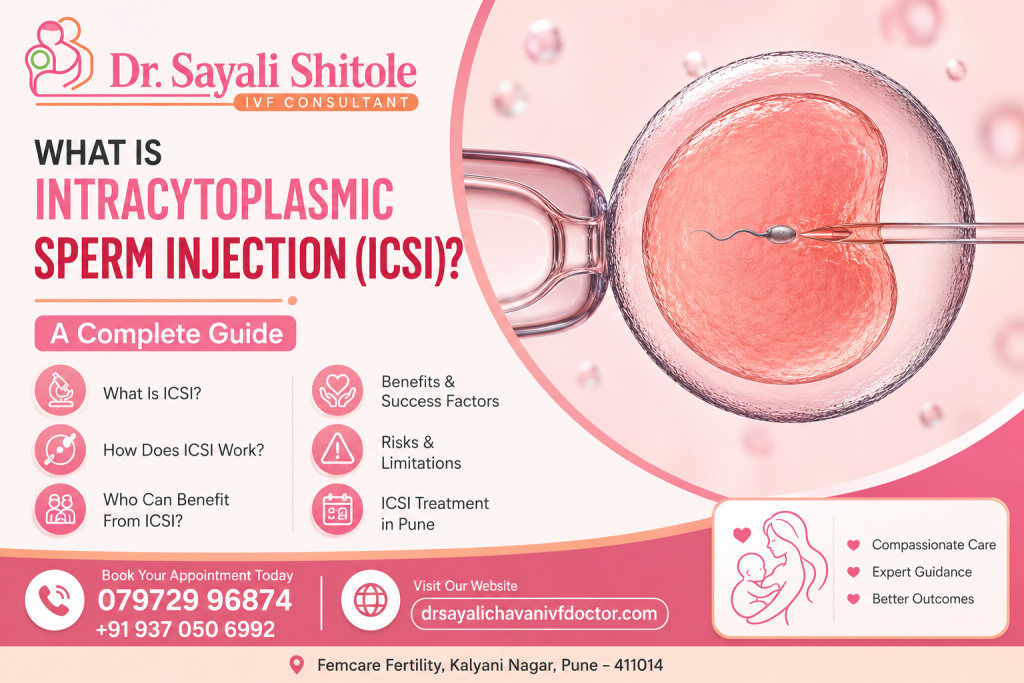
Intracytoplasmic Sperm Injection (ICSI) is an advanced fertility treatment used as part of an IVF cycle to help fertilize an egg when sperm are unable to fertilize the egg effectively on their own. During ICSI, an embryologist carefully selects a single sperm and injects it directly into a mature egg using specialized laboratory equipment.
ICSI is particularly useful in cases of male factor infertility , including very low sperm count, poor sperm movement, abnormal sperm shape, or previous IVF cycles in which fertilization was unsuccessful or lower than expected. However, ICSI is not automatically necessary for every IVF cycle. The decision should be based on the couple’s fertility history, sperm and egg factors, previous treatment outcomes, and the advice of a fertility specialist.
For couples considering advanced fertility treatment, consulting an experienced IVF Specialist in Pune – Dr. Sayali Chavan Shitole can help determine whether conventional IVF or ICSI is more appropriate for their individual situation.
What Is Intracytoplasmic Sperm Injection?
Intracytoplasmic Sperm Injection, commonly called ICSI, is a specialized laboratory fertilization technique used during IVF treatment in pune In conventional IVF, several prepared sperm are placed around an egg in the laboratory. Fertilization occurs when one sperm naturally penetrates the egg. In ICSI, the process is different. Instead of waiting for a sperm to penetrate the egg naturally, an embryologist uses a very fine injection needle to introduce one selected sperm directly into the cytoplasm of the mature egg.
The basic process is:
Egg retrieval → Sperm preparation → Sperm selection → Direct sperm injection → Fertilization assessment → Embryo development → Embryo transfer
ICSI was originally developed to overcome difficulties with fertilization, particularly in couples affected by significant male factor infertility. Current evidence continues to support its role in selected cases, especially when there is a clear risk of poor or failed fertilization.
Why Is ICSI Used in IVF?
The main purpose of ICSI is to overcome certain barriers to fertilization. Even when eggs and sperm are brought together during conventional IVF, fertilization may not occur. This can happen because the sperm may have difficulty reaching, attaching to, or penetrating the egg. ICSI bypasses several of these steps by allowing the embryologist to place a single sperm directly inside the egg. It may therefore be considered when there is:
- Very low sperm count
- Poor sperm motility
- Significant abnormalities in sperm morphology
- Previous failure of fertilization with conventional IVF
- Very low or absent fertilization in an earlier IVF cycle
- Surgically retrieved sperm
- Certain severe male-factor infertility conditions
- Use of previously frozen eggs in appropriate circumstances
- Specific situations involving genetic testing where ICSI may be clinically appropriate
The exact indication varies from patient to patient. ICSI should not be considered a guaranteed way to improve pregnancy or live-birth rates in every IVF cycle.
Who May Benefit From ICSI?
ICSI is most commonly considered when there is a significant concern about sperm-related fertilization.
1. Severe Male Factor Infertility
- Men with a very low sperm count, poor sperm movement, or significant sperm abnormalities may have difficulty achieving fertilization through conventional IVF.
- ICSI allows the embryology team to select an individual sperm and inject it directly into a mature egg.
2. Previous Fertilization Failure
- If a previous IVF cycle resulted in little or no fertilization despite apparently suitable eggs and sperm, ICSI may be considered in a subsequent cycle.
- The objective is to reduce the possibility of another fertilization failure.
3. Surgically Retrieved Sperm
- Some men have sperm production within the testes but very few or no sperm available in the ejaculate.
- In selected cases, sperm may be retrieved surgically and then used for ICSI.
4. Certain Sperm Quality Problems
- Problems involving sperm concentration, movement, or morphology can sometimes make conventional fertilization more difficult.
- Depending on the overall fertility assessment, ICSI may be recommended to improve the likelihood of fertilization.
5. Previously Cryopreserved Eggs
- When frozen eggs are thawed for fertility treatment, ICSI is commonly used to achieve fertilization because the freezing and thawing process can affect the egg’s outer layer.
- The fertility team will decide the most appropriate fertilization method based on the individual case.
6. Selected Genetic Testing Situations
- ICSI may be considered in some cycles involving preimplantation genetic testing, particularly where avoiding contamination from additional sperm is important for the accuracy of testing.
- However, ICSI is not automatically required simply because genetic testing is planned.
Is ICSI Required for Every IVF Cycle?
No.
This is an important point for couples considering IVF. ICSI is a specialized fertilization technique, not a compulsory part of every IVF treatment. According to the American Society for Reproductive Medicine’s 2026 committee opinion, routine ICSI for patients without male-factor infertility or a history of fertilization failure does not improve live-birth outcomes compared with conventional IVF. Therefore, the treatment should be individualized rather than automatically added to every IVF cycle.
For this reason, a fertility specialist may recommend:
- Conventional IVF
- IVF with ICSI
- ICSI for selected eggs
- Another fertility treatment depending on the diagnosis
The decision should be based on medical evidence and the patient’s specific circumstances.
How Does ICSI Work? Step-by-Step Process
Understanding the ICSI process can make fertility treatment less confusing.
Step 1: Ovarian Stimulation
- The IVF cycle usually begins with medications that stimulate the ovaries to develop multiple follicles.
- The development of follicles is monitored through ultrasound scans and, when required, blood tests.
- The aim is to obtain mature eggs that can potentially be fertilized.
Step 2: Egg Retrieval
- Once the follicles reach an appropriate stage of development, medication is given to trigger final egg maturation.
- Egg retrieval is then performed using a specialized needle, usually under sedation or anesthesia.
- The retrieved eggs are immediately transferred to the embryology laboratory.
Step 3: Sperm Collection
- A semen sample is generally collected on the day of egg retrieval.
- If ejaculation is not possible or sperm are not present in the semen because of certain medical conditions, sperm may sometimes be obtained using a surgical sperm-retrieval technique.
Step 4: Sperm Preparation
- The laboratory team processes the semen sample to identify suitable sperm.
- The embryologist evaluates the available sperm and selects an individual sperm for injection.
Step 5: Sperm Selection
- A healthy-looking, suitable sperm is selected under a high-powered microscope.
- The embryologist immobilizes and carefully positions the selected sperm before injection.
Step 6: Direct Injection Into the Egg
- This is the defining step of ICSI.
- A very fine injection pipette is used to hold the egg securely. Another fine needle is used to carefully inject the selected sperm directly into the egg’s cytoplasm.
- This requires significant embryology laboratory expertise and specialized equipment.
Step 7: Fertilization Assessment
- The injected eggs are kept in controlled laboratory conditions.
- The embryology team checks the eggs after the appropriate interval to determine whether normal fertilization has occurred.
- Not every injected egg will fertilize, and not every fertilized egg will develop into a healthy embryo.
Step 8: Embryo Development
- Successfully fertilized eggs begin dividing and developing into embryos.
- Embryologists monitor embryo development over the following days.
- Depending on the treatment plan, embryos may be transferred into the uterus or frozen for future use.
Step 9: Embryo Transfer
- A suitable embryo may be transferred into the uterus.
- The number and timing of embryos transferred depend on factors such as age, embryo quality, treatment history, and the recommendations of the fertility team.
Step 10: Pregnancy Testing
- After embryo transfer, the patient waits for the appropriate time before taking a pregnancy test.
- A blood test measuring beta-hCG is commonly used to determine whether implantation has resulted in pregnancy.
What Happens to the Egg During ICSI?
- During ICSI, the egg is held carefully using a specialized pipette.
- The embryologist then introduces a fine needle into the egg and deposits one sperm inside.
- The needle is subsequently removed carefully.
- The egg is then placed back into controlled laboratory culture conditions and observed for signs of normal fertilization.
- It is important to understand that injecting a sperm into an egg does not guarantee fertilization. Egg maturity and quality, sperm characteristics, laboratory conditions, and other biological factors can influence the outcome.
ICSI vs Conventional IVF: What Is the Difference?
Both IVF and ICSI involve retrieving eggs, fertilizing them in a laboratory, developing embryos, and transferring an embryo into the uterus. The main difference is how fertilization occurs.
| Conventional IVF | ICSI |
|---|---|
| Prepared sperm are placed around the egg | One selected sperm is injected directly into the egg |
| Fertilization occurs without direct sperm injection | Fertilization is assisted by direct injection |
| Often suitable when sperm parameters are adequate | Particularly useful in selected male-factor cases |
| Does not require individual sperm injection | Requires specialized embryology equipment and expertise |
| May be appropriate for many standard IVF cycles | Used when there is a clinical indication |
Neither method is universally better for every patient. The appropriate technique depends on the reason for infertility and the likelihood of successful fertilization.
What Are the Advantages of ICSI?
When appropriately indicated, ICSI can provide several important advantages.
1. Helps Overcome Certain Male Infertility Problems
ICSI can be particularly valuable when sperm count, motility, or morphology makes conventional fertilization difficult.
2. May Reduce the Risk of Fertilization Failure
For patients who previously experienced poor or failed fertilization through conventional IVF, ICSI can increase the likelihood of obtaining fertilized eggs.
3. Can Be Used With Surgically Retrieved Sperm
ICSI allows certain patients with severe male-factor infertility to use sperm obtained through surgical retrieval procedures.
4. Useful With Frozen Eggs
ICSI is commonly used when fertilization is being attempted with previously cryopreserved eggs.
5. Allows Precise Laboratory Fertilization
Rather than relying entirely on the sperm’s ability to penetrate the egg naturally, ICSI enables the embryologist to introduce a selected sperm directly into the egg.
Does ICSI Guarantee Pregnancy?
No. ICSI helps address the fertilization stage of IVF, but pregnancy depends on several stages of the reproductive process. Successful fertilization does not automatically mean that:
- The embryo will develop normally
- The embryo will implant
- Pregnancy will continue
- A live birth will occur
Factors such as maternal age, ovarian reserve, egg quality, sperm quality, embryo development, uterine factors, underlying medical conditions, and other individual circumstances can influence IVF outcomes. Therefore, ICSI should not be described as a guaranteed method for achieving pregnancy.
What Are the Risks and Limitations of ICSI?
ICSI is generally considered an established fertility treatment, but like every medical procedure, it has limitations and potential risks.
1. Not Every Egg Will Fertilize
Even after sperm injection, some eggs may not fertilize normally.
2. Not Every Fertilized Egg Becomes an Embryo
Embryonic development depends on the biological quality of the egg and sperm and other factors.
3. Egg-Related Risks
The egg may be damaged during the injection procedure in a small proportion of cases.
4. Additional Laboratory Expertise Is Required
ICSI requires specialized embryology equipment, training, and laboratory expertise.
5. Additional Cost
Because ICSI involves a more specialized laboratory procedure, it may increase the overall cost of an IVF cycle.
Potential Genetic and Birth-Outcome Considerations
ICSI is associated with a small increased risk of certain birth defects in some studies, although it can be difficult to separate the effect of ICSI from the underlying infertility factors. Patients should discuss their individual risks with their fertility specialist. For this reason, ICSI should be recommended when there is a reasonable clinical indication rather than simply because it is a more advanced procedure.
Is ICSI Painful?
- The ICSI procedure itself is performed in the embryology laboratory and is not something the patient feels.
- The patient may experience discomfort or cramping associated with other parts of the IVF cycle, particularly ovarian stimulation and egg retrieval.
- The egg retrieval procedure is generally performed with appropriate pain relief or sedation.
How Long Does ICSI Take?
- The direct sperm injection itself is a laboratory procedure performed on the day of egg retrieval.
- However, ICSI is not a separate treatment cycle from IVF. It is one part of the overall IVF process.
- The complete treatment timeline can include:
- Initial fertility evaluation
- Ovarian stimulation
- Monitoring
- Egg retrieval
- ICSI
- Fertilization assessment
- Embryo culture
- Fresh or frozen embryo transfer
- Pregnancy testing
The exact timeline varies depending on the treatment protocol.
What Factors Affect ICSI Success?
- ICSI success cannot be predicted from the injection procedure alone.
- Important factors include:
- Female Age: Age is one of the most important factors affecting egg quality and reproductive outcomes.
- Egg Quality: The maturity and biological quality of the retrieved eggs influence fertilization and embryo development.
- Sperm Quality: Although ICSI can help overcome some sperm-related problems, sperm quality can still influence embryo development.
- Embryo Quality: Not every fertilized egg develops into an embryo suitable for transfer.
- Ovarian Reserve: Ovarian reserve can influence the number of eggs available for treatment.
- Uterine and Endometrial Factors: The condition of the uterus and endometrium can affect implantation.
- Underlying Medical Conditions: Conditions affecting reproductive health may influence treatment outcomes.
- Laboratory Quality: Embryology laboratory standards, equipment, protocols, and experience are important components of assisted reproductive treatment.
ICSI for Male Infertility
Male infertility is one of the most important reasons ICSI is recommended.
Male-factor infertility may involve:
- Low sperm concentration
- Reduced sperm motility
- Abnormal sperm morphology
- Difficulty producing an ejaculate
- Previous poor fertilization
- Certain sperm production disorders
- Obstruction of the reproductive tract
- Surgically retrieved sperm
A detailed semen analysis and medical evaluation help determine the most suitable treatment approach. ICSI can overcome some barriers to fertilization, but the underlying cause of male infertility should also be investigated whenever appropriate.
ICSI With Surgically Retrieved Sperm
- Some men may have no sperm or very few sperm in the ejaculate but may still have sperm available within the reproductive tract or testes.
- Depending on the cause, sperm retrieval procedures may be considered.
- If usable sperm are obtained, ICSI can allow a single sperm to be injected into an egg.
- This can be an important option for selected couples dealing with severe male infertility.
Can ICSI Be Used With Frozen Eggs?
Yes. ICSI is commonly used when previously frozen eggs are thawed for fertility treatment. After thawing, mature eggs can be evaluated and suitable eggs can undergo ICSI. Not every frozen egg will survive the thawing process, and not every surviving egg will fertilize. The number and quality of eggs available can influence the overall chance of obtaining embryos.
ICSI and Embryo Development
After successful fertilization, the embryo is cultured under controlled laboratory conditions. Embryologists monitor:
- Cell division
- Developmental progression
- Embryo morphology
- Fragmentation
- Blastocyst development
Some embryos may reach the blastocyst stage around day 5 or 6. Depending on the treatment plan, an embryo may then be selected for transfer or cryopreservation.
What Is the Difference Between ICSI and IUI?
- ICSI and IUI are very different fertility treatments.
- IUI (Intrauterine Insemination) involves placing prepared sperm directly into the uterus around the time of ovulation. Fertilization still takes place inside the woman’s reproductive tract.
- ICSI, on the other hand, is performed as part of IVF. The egg is retrieved and fertilization occurs in the laboratory through direct sperm injection.
- IUI may be considered for selected cases of mild infertility, while IVF with ICSI is generally used for more complex fertility problems or specific indications.
Is ICSI Better Than IVF?
- ICSI is not necessarily “better” than conventional IVF.
- Instead, it is a different fertilization method used within IVF.
- ICSI can be particularly useful when there is a clear risk of poor fertilization, especially because of male-factor infertility or previous fertilization failure.
- For patients without male-factor infertility or previous fertilization problems, current evidence does not support automatically using ICSI for every egg.
- A fertility specialist should therefore recommend the fertilization method according to the patient’s individual diagnosis.
ICSI Treatment in Pune
Couples looking for advanced fertility treatment in Pune can discuss their individual fertility concerns with a qualified reproductive medicine specialist.
Dr. Sayali Chavan Shitole is an IVF and fertility specialist practising at Femcare Fertility in Kalyani Nagar, Pune. Her fertility care includes IVF, ICSI, IUI, fertility preservation, hysteroscopy, and other reproductive medicine services. Her approach focuses on understanding the individual fertility problem before selecting an appropriate treatment plan.
Visit Dr. Sayali Chavan Shitole’s IVF & Fertility Website
For couples searching for an IVF Specialist in Pune, the right treatment should be based on a proper fertility evaluation rather than choosing a procedure simply because it is considered more advanced.
Why Choose an IVF Specialist for ICSI?
ICSI involves several important decisions before, during, and after the laboratory procedure.
A fertility specialist can assess both partners and determine whether ICSI is appropriate based on:
- Medical history
- Semen analysis
- Ovarian reserve
- Age
- Previous fertility treatments
- Previous fertilization results
- Egg and sperm factors
- Reproductive history
- Embryology considerations
Personalized treatment planning is especially important because ICSI addresses fertilization, while infertility itself can have many different causes.
Frequently Asked Questions About ICSI
What does ICSI stand for?
ICSI stands for Intracytoplasmic Sperm Injection. It is an IVF laboratory technique in which a single sperm is injected directly into a mature egg.
Is ICSI part of IVF?
Yes. ICSI is a fertilization technique performed as part of an IVF treatment cycle.
Why is ICSI used?
It is primarily used when there is a significant risk of poor or failed fertilization, particularly in cases of male-factor infertility or previous fertilization failure.
Is ICSI necessary for every IVF patient?
No. ICSI is not required for every IVF cycle. The decision should be based on the individual clinical situation.
Does ICSI guarantee fertilization?
No. Although ICSI can help overcome certain barriers to fertilization, not every injected egg will fertilize normally.
Does ICSI guarantee pregnancy?
No. ICSI addresses fertilization, but pregnancy and live birth depend on many additional biological and clinical factors.
Is ICSI painful?
The ICSI injection is performed on the egg in the laboratory, so the patient does not feel the injection. Discomfort associated with IVF usually comes from ovarian stimulation or egg retrieval rather than ICSI itself.
Can ICSI be used for severe male infertility?
Yes. ICSI is particularly useful in selected cases of severe male-factor infertility and may also be used with surgically retrieved sperm.
Can ICSI be performed with frozen eggs?
Yes. ICSI is commonly used to fertilize suitable mature eggs after thawing.
How is ICSI different from conventional IVF?
In conventional IVF, sperm and eggs are placed together and fertilization occurs naturally in the laboratory. With ICSI, one selected sperm is directly injected into the egg.
How is ICSI different from IUI?
IUI places prepared sperm into the uterus, where fertilization occurs naturally inside the body. ICSI involves egg retrieval and laboratory fertilization as part of IVF.
Who decides whether ICSI is needed?
The fertility specialist, in consultation with the embryology team and the couple, determines whether ICSI is appropriate based on the patient’s fertility factors and treatment history.
Final Takeaway
Intracytoplasmic Sperm Injection (ICSI) is an important advancement in assisted reproductive technology that can help selected couples overcome fertilization difficulties. By injecting a single sperm directly into a mature egg, ICSI can be particularly valuable in cases of significant male-factor infertility or previous fertilization failure.
However, ICSI is not a universal requirement for IVF and does not guarantee pregnancy or a live birth. The most appropriate treatment depends on the cause of infertility, egg and sperm factors, previous treatment history, and individual reproductive goals.
If you are considering IVF or ICSI in Pune, a detailed fertility evaluation can help determine whether conventional IVF, ICSI, IUI, or another treatment approach is appropriate for you.
For personalized fertility guidance, you can consult Dr. Sayali Chavan Shitole, IVF and Fertility Specialist in Pune, at Femcare Fertility, Kalyani Nagar.
Website: https://drsayalichavanivfdoctor.com/

Dr. Sayali Chavan - Shitole
Dr. Sayali Shitole IVF & Fertility Specialist in Pune is a reliable and among the IVF Clinic in Pune & IVF Centre in Pune. Dr. Sayali Shitole is equipped with all ultra-modern facilities IVF Clinic/IVF Centre and Test Tube Baby Centre in Pune.