Understanding the egg donor process step by step can help couples know what happens before, during, and after donor egg treatment. From donor screening and medical evaluation to egg retrieval, fertilisation, embryo development and embryo transfer, every stage requires careful planning.
For some women, using their own eggs during IVF may not be the most suitable option because of low ovarian reserve, reduced egg quality, advanced reproductive age, premature ovarian insufficiency, certain genetic conditions, or previous unsuccessful fertility treatment. In such situations, donor egg IVF may be considered after a detailed fertility evaluation.
Dr. Sayali Chavan Shitole, IVF Specialist in Pune, provides personalised fertility treatment planning based on the patient’s medical history, reproductive health, previous treatment and individual fertility needs. She provides fertility care through Femcare Fertility and works with patients from areas including Viman Nagar and Kharadi. Her practice includes IVF, ICSI, IUI and other fertility treatments.
What Is Donor Egg IVF?
Donor egg IVF is an assisted reproductive treatment in which eggs obtained from an eligible egg donor are fertilised with sperm in an IVF laboratory. The resulting embryos are then transferred into the uterus of the intended mother after appropriate preparation of the uterine lining.
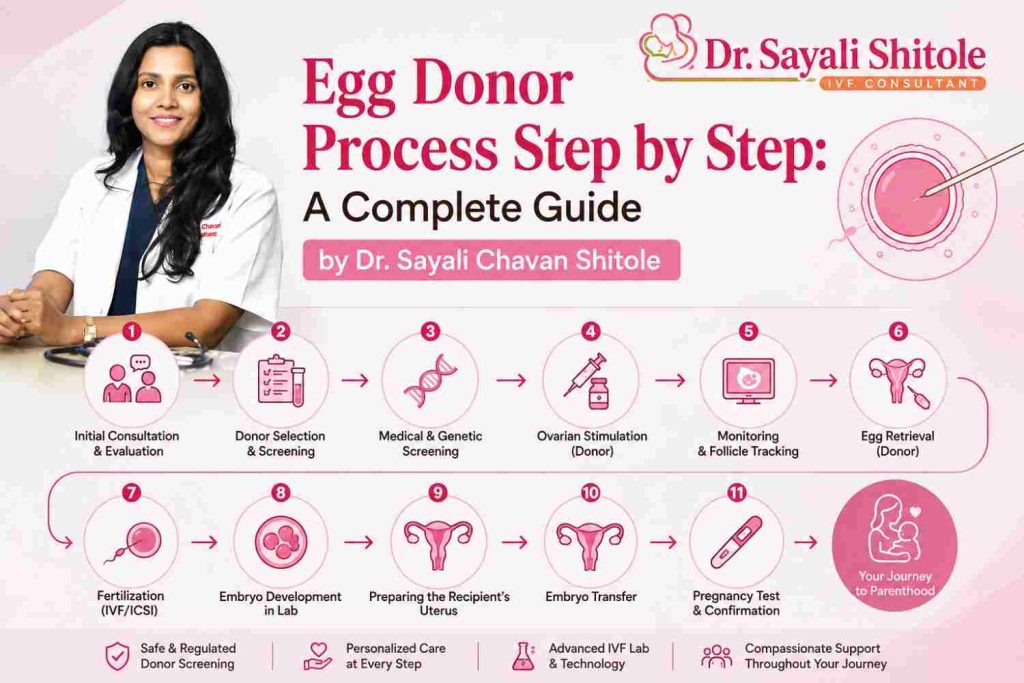
In simple terms: Egg Donor Process Step by Step
Egg donor → Egg retrieval → Fertilisation → Embryo development → Uterine preparation → Embryo transfer → Pregnancy testing
The treatment does not mean that every patient needs donor eggs. The decision depends on the woman’s ovarian reserve, egg quality, age, medical history, previous fertility treatment and other factors.
Egg Donor Process Step by Step
The exact treatment plan can differ from one patient to another. However, the general egg donor process step by step involves the following stages.
Step 1: Initial Consultation With Dr. Sayali Chavan Shitole
The first step is a detailed consultation with a fertility specialist.
Dr. Sayali Chavan Shitole IVF Specialist in Pune reviews the couple’s fertility history and determines whether donor egg treatment may be appropriate.
During the consultation, the doctor may discuss:
- Previous pregnancy history
- Previous IVF or IUI treatment
- Menstrual history
- Age and reproductive history
- Ovarian reserve
- Previous fertility reports
- Medical and surgical history
- Family history
- Male partner’s fertility assessment
- Previous embryo development or implantation outcomes
The purpose of this consultation is to understand why pregnancy has been difficult and whether donor egg IVF is medically appropriate.
Step 2: Fertility Evaluation of the Recipient
Before proceeding with donor eggs, the intended mother usually undergoes a fertility evaluation. Depending on the individual case, investigations may include:
- Transvaginal ultrasound
- Ovarian reserve assessment
- AMH testing
- Hormonal investigations
- Uterine evaluation
- Relevant blood investigations
- Medical history assessment
- Other tests recommended by the fertility specialist
The condition of the uterus is particularly important because the embryo created from the donor egg will eventually need to implant in the recipient’s uterine lining. If conditions such as uterine polyps, fibroids, adhesions or other abnormalities are identified, the doctor may recommend appropriate evaluation or treatment before embryo transfer.
Step 3: Understanding Why Donor Eggs May Be Recommended
Donor eggs may be considered when the chances of creating suitable embryos using the patient’s own eggs are expected to be limited.
Possible situations include:
- Diminished ovarian reserve
- Premature ovarian insufficiency
- Significant reduction in egg quality
- Advanced reproductive age
- Repeated IVF cycles with poor embryo development
- Certain inherited genetic conditions
- Some cases of repeated IVF failure
However, these conditions do not automatically mean that donor eggs are required. Dr. Sayali Chavan Shitole IVF Specialist in Pune can review the patient’s previous reports and treatment history before discussing whether donor egg IVF is an appropriate option.
Step 4: Donor Selection Through the Appropriate ART Framework
- Once donor egg treatment is considered appropriate, an eligible donor is identified through the applicable ART framework.
- Egg donation in India is regulated under the Assisted Reproductive Technology (Regulation) Act, 2021.
- The law provides requirements relating to ART clinics, ART banks and gamete donation. Patients should undergo donor treatment through appropriately registered and regulated facilities.
- The selection process is not simply based on choosing an individual donor. Medical screening, eligibility requirements, documentation and applicable regulations are important parts of the process.
Step 5: Medical Screening of the Egg Donor
The donor undergoes medical assessment before eggs are collected. The screening process may include:
- Detailed medical history
- Family history
- Physical assessment
- Reproductive health evaluation
- Ultrasound assessment
- Infectious disease screening
- Relevant genetic screening
- Other investigations required under the applicable clinical protocol
The objective is to identify relevant medical and genetic risks before donor eggs are used. This screening also helps protect the donor’s health during the treatment process.
Step 6: Genetic Evaluation of the Donor
- Genetic screening can be an important part of donor evaluation.
- Depending on the donor’s medical and family history and the applicable protocol, testing may assess carrier status for selected inherited conditions.
- If a significant genetic concern is identified, further evaluation or genetic counselling may be recommended.
- Patients should discuss what donor screening information is available and how it is reviewed with their fertility specialist before proceeding.
Step 7: Donor Consent and Counselling
Egg donation involves more than a medical procedure. The donor should understand:
- The purpose of treatment
- Ovarian stimulation
- Monitoring appointments
- Egg retrieval
- Possible side effects
- Potential medical risks
- Consent requirements
- Applicable confidentiality and regulatory considerations
Counselling may also be recommended because donor conception can involve emotional and psychological considerations for both donors and intended parents.
Step 8: Preparing the Donor for Ovarian Stimulation
- Once the donor is cleared for treatment, ovarian stimulation begins according to the fertility specialist’s protocol.
- The donor receives fertility medications that encourage the ovaries to develop multiple follicles.
- Regular monitoring is performed through ultrasound scans and, when required, blood tests.
- The doctor adjusts treatment according to the donor’s response.
- The aim is to obtain an appropriate number of mature eggs while monitoring the donor’s safety throughout the cycle.
Step 9: Monitoring Follicle Development
During ovarian stimulation, the donor attends monitoring appointments. The fertility team assesses:
- Number of developing follicles
- Follicle size
- Ovarian response
- Hormonal response where required
- Overall treatment progress
Monitoring helps the doctor decide when the follicles are ready for the next stage. The treatment schedule is individualised because ovarian response can differ between donors.
Step 10: Final Egg Maturation
- When the follicles have reached the appropriate stage of development, medication is given to trigger final maturation of the eggs.
- The timing of this medication is important.
- Egg retrieval is scheduled according to the expected maturation period, and the donor receives specific instructions from the fertility team regarding the medication and procedure timing.
Step 11: Egg Retrieval From the Donor
- Egg retrieval is performed using a transvaginal ultrasound-guided procedure.
- A specialised needle is carefully guided into the ovarian follicles to collect the eggs.
- The procedure is performed under appropriate medical supervision, with sedation or anaesthesia according to the clinical protocol.
- After the procedure, the donor is monitored during recovery.
- The collected eggs are then transferred to the embryology laboratory.
Step 12: Fertilisation of Donor Eggs
- After egg retrieval, the mature eggs are fertilised with sperm.
- Depending on the couple’s medical circumstances, fertilisation may be performed through conventional IVF or ICSI.
- With ICSI, a selected sperm is injected directly into a mature egg.
- The fertility specialist and embryology team determine the appropriate fertilisation approach based on the treatment plan.
Step 13: Embryo Development in the Laboratory
- After fertilisation, the resulting embryos are monitored in the IVF laboratory.
- Embryologists assess embryo development over the following days.
- Importantly, the number of eggs retrieved does not mean the same number of embryos will be available.
- Some eggs may not fertilise, and some fertilised eggs may not continue developing.
- This is why the fertility team discusses realistic expectations rather than guaranteeing a particular number of embryos.
Step 14: Preparing the Recipient’s Uterus
- While the embryo is developing, the recipient’s uterine lining is prepared for embryo transfer.
- Hormonal medication may be prescribed according to the selected treatment protocol.
- The doctor monitors the endometrium through ultrasound and other assessments when required.
- The objective is to prepare a suitable uterine environment for embryo implantation.
Step 15: Embryo Transfer
- Once the embryo and uterine lining are ready, the selected embryo is transferred into the uterus.
- A thin catheter is gently passed through the cervix into the uterus.
- The embryo is then placed inside the uterine cavity.
- Embryo transfer is generally a relatively simple procedure and does not involve retrieving eggs from the recipient.
- After transfer, the patient continues the prescribed medications and follows the fertility team’s instructions.
Step 16: Pregnancy Test
- A pregnancy test is performed after the recommended interval following embryo transfer.
- If the test is positive, the fertility team may recommend blood tests and an early ultrasound to assess the pregnancy.
- If the result is negative, the doctor reviews the treatment cycle and discusses the next available options.
- If additional embryos have been frozen, another embryo transfer may be considered where medically appropriate.
How Long Does the Egg Donor Process Take?
- The timeline can vary depending on donor availability, screening, recipient preparation, embryo development and the selected treatment protocol.
- The donor’s stimulation and monitoring take place over a treatment cycle, followed by egg retrieval.
- The recipient’s uterine preparation may occur alongside the donor cycle or separately if embryos are frozen for later transfer.
- Therefore, there is no single timeline that applies to every donor egg IVF treatment.
- During consultation, Dr. Sayali Chavan Shitole IVF Specialist in Pune can explain the expected treatment schedule based on the individual case.
Who May Be Recommended Donor Egg IVF?
Donor egg IVF may be considered for selected patients with:
1. Low Ovarian Reserve
When the ovaries have a significantly reduced number of available eggs, donor eggs may be discussed as one treatment option.
2. Reduced Egg Quality
Egg quality can decline with reproductive age. In selected situations, donor eggs may be considered after evaluating previous treatment results and other fertility factors.
3. Premature Ovarian Insufficiency
Women with premature loss or significant reduction of ovarian function may be candidates for donor egg treatment in appropriate circumstances.
4. Repeated IVF Failure
Some women may consider donor eggs after repeated IVF attempts, particularly when poor egg or embryo development is suspected to be an important factor.
5. Certain Genetic Conditions
If there is a significant inherited genetic concern associated with the woman’s own eggs, donor eggs may sometimes be discussed as an option. The decision should be individualised rather than based on age or a single test result.
Donor Egg IVF at Femcare Fertility for Patients From Viman Nagar
- Patients from Viman Nagar, Kharadi and surrounding areas of Pune may seek fertility consultation with Dr. Sayali Chavan Shitole at Femcare Fertility in Kalyani Nagar.
- The verified Femcare Fertility listing places the clinic at 1st Floor, Suman Business Park, Opd No 2 Femcare Fertility Office 102, Kalyani Nagar, Pune, Maharashtra 411014
- The clinic’s listed fertility services include IVF, IUI, ICSI, fertility preservation and donor egg IVF.
- For patients travelling from Viman Nagar, Kharadi, Wadgaon Sheri, Koregaon Park and nearby areas, having a planned fertility consultation can help them understand whether donor egg IVF is suitable before starting treatment.
Donor Egg IVF at IRSA Fertility Clinic, Kharadi
Patients looking for fertility care around Kharadi, Pune may also discuss donor egg treatment and their available treatment options with their fertility specialist at IRSA Fertility Clinic, Kharadi. For couples considering donor egg IVF, the important first step is not simply choosing a treatment. It is understanding why donor eggs are being considered, what investigations are required, how donor screening is performed and how the embryo transfer will be planned. A personalised consultation with Dr. Sayali Chavan Shitole IVF Specialist in Pune can help patients understand the treatment pathway according to their individual fertility history.
What Are the Benefits of Donor Egg IVF?
Donor egg IVF may provide an option for women whose own eggs may not be suitable for IVF because of certain medical or reproductive factors.
Potential advantages include:
- Access to donor oocytes after appropriate screening
- An option when ovarian reserve is severely reduced
- An alternative when egg quality is a significant concern
- An option for selected genetic conditions
- The possibility of creating embryos for transfer using donor eggs
However, donor egg IVF does not guarantee pregnancy or a successful birth. Pregnancy outcomes depend on multiple factors, including embryo development, uterine health, sperm factors, maternal health and pregnancy-related factors.
What Are the Risks of Egg Donation?
Egg donation involves medical procedures and therefore carries potential risks. For the donor, these may include:
- Abdominal discomfort or bloating
- Ovarian hyperstimulation
- Medication-related side effects
- Bleeding
- Infection
- Complications associated with egg retrieval
- Sedation or anaesthesia-related risks
For the recipient, risks are associated with fertility medication, embryo transfer and pregnancy. The fertility team should explain these risks before treatment and provide appropriate monitoring throughout the process.
Is Donor Egg IVF Safe?
- Donor egg IVF is a medically established form of assisted reproduction, but no fertility treatment is completely risk-free.
- Safety depends on appropriate donor screening, medical assessment, regulated ART practice, careful ovarian stimulation, laboratory procedures and monitoring.
- Patients should choose an appropriately regulated fertility service and discuss the treatment risks with their fertility specialist before proceeding.
Questions to Ask Your IVF Specialist Before Donor Egg Treatment
Before starting donor egg IVF, couples can ask:
- Why are donor eggs being recommended in my case?
- Can I still consider IVF using my own eggs?
- What tests do I need before donor egg treatment?
- How is the donor screened?
- What medical and genetic information is available?
- How are the donor eggs retrieved?
- Will IVF or ICSI be used for fertilisation?
- How will my uterine lining be prepared?
- Will the embryo transfer be fresh or frozen?
- What happens if the first transfer does not result in pregnancy?
- Are additional embryos available for future transfer?
- What are the applicable ART regulations and consent requirements?
Why Choose Personalised Fertility Guidance?
Every fertility journey is different. Two women of the same age can have very different ovarian reserve, medical histories and treatment responses. Similarly, two couples with previous IVF failure may have completely different reasons for unsuccessful treatment. This is why donor egg IVF should not be approached as a standard package.
Dr. Sayali Chavan Shitole IVF Specialist in Pune focuses on evaluating the patient’s fertility history and developing an individual treatment plan. Her qualifications include MBBS, DGO and a Fellowship in Reproductive Medicine, and she provides IVF, ICSI, IUI and fertility-related care at Femcare Fertility in Kalyani Nagar, Pune.
When Should You Consult an IVF Specialist?
You may consider consulting a fertility specialist if:
- You have been advised that your ovarian reserve is low.
- Previous IVF cycles produced few or poor-quality embryos.
- You have experienced repeated IVF failure.
- You have premature ovarian insufficiency.
- You are concerned about a genetic condition.
- You have been advised to consider donor eggs.
- You want to understand your fertility options before starting treatment.
A consultation allows the doctor to review your reports and explain whether donor egg IVF is appropriate for your particular situation.
Egg Donor Process Step by Step: Final Takeaway
- The egg donor process step by step involves several stages, including recipient evaluation, donor selection, donor screening, ovarian stimulation, egg retrieval, fertilisation, embryo development, preparation of the recipient’s uterine lining and embryo transfer.
- Donor egg IVF can be an important treatment option for selected women whose own eggs may not be suitable for IVF. However, the decision should be made only after proper medical evaluation and counselling.
- If you are considering donor egg IVF in Pune, Dr. Sayali Chavan Shitole IVF Specialist in Pune can help you understand the available treatment options and whether donor egg treatment may be appropriate for your fertility needs.
- Patients from Viman Nagar, Kharadi and nearby areas can discuss their fertility concerns and treatment options through a personalised consultation at the appropriate fertility centre.
Frequently Asked Questions
1. What is the egg donor process step by step?
The process generally includes recipient evaluation, donor selection and screening, ovarian stimulation, egg retrieval, fertilisation, embryo culture, preparation of the recipient’s uterus and embryo transfer.
2. Who may need donor eggs for IVF?
Donor eggs may be considered for selected women with significantly reduced ovarian reserve, premature ovarian insufficiency, certain egg-quality concerns, repeated unsuccessful IVF treatment or specific genetic conditions.
3. Does the recipient undergo egg retrieval during donor egg IVF?
No. The eggs are retrieved from the donor. The recipient undergoes preparation of the uterus and receives the resulting embryo.
4. Are donor eggs screened before IVF?
Yes. Donor evaluation involves appropriate medical, infectious-disease and genetic screening according to applicable requirements and clinical protocols.
5. Can donor eggs be fertilised using ICSI?
Yes. Depending on the sperm-related and treatment factors, ICSI may be used to fertilise donor eggs.
6. Is donor egg IVF guaranteed to result in pregnancy?
No. Donor egg IVF cannot guarantee pregnancy. The outcome depends on several factors, including embryo development, uterine health, sperm factors and maternal health.
7. Where can patients from Viman Nagar and Kharadi discuss donor egg IVF?
Patients from Viman Nagar and Kharadi can seek a consultation with a fertility specialist and discuss whether donor egg IVF is suitable for their individual circumstances. Dr. Sayali Chavan Shitole provides fertility care at Femcare Fertility in Kalyani Nagar, Pune.

Dr. Sayali Chavan - Shitole
Dr. Sayali Shitole IVF & Fertility Specialist in Pune is a reliable and among the IVF Clinic in Pune & IVF Centre in Pune. Dr. Sayali Shitole is equipped with all ultra-modern facilities IVF Clinic/IVF Centre and Test Tube Baby Centre in Pune.