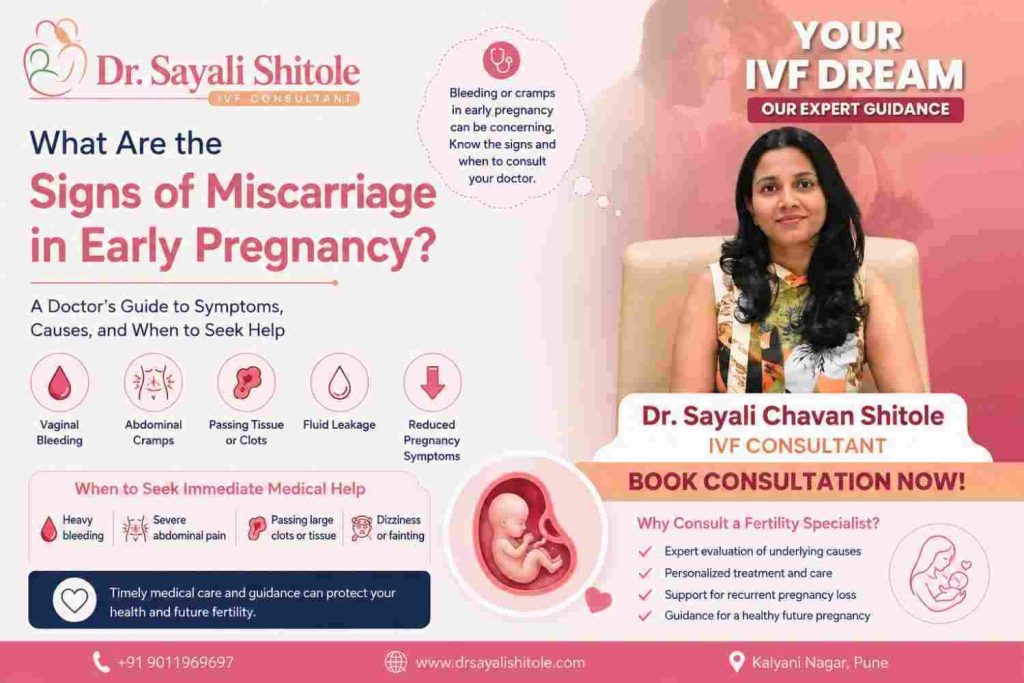
As a fertility specialist, one of the questions I often hear from women in early pregnancy is, What are the signs of miscarriage in early pregnancy? Seeing blood or experiencing abdominal pain can be frightening, especially when you have been waiting a long time for a positive pregnancy test. The most common symptoms associated with miscarriage are vaginal bleeding and lower abdominal cramping or pain. Some women may also notice passing tissue or fluid. However, I always advise my patients not to assume that bleeding automatically means miscarriage. Bleeding and pain can occur for several reasons during early pregnancy, and proper medical assessment is needed to understand what is actually happening.
If you have conceived after fertility treatment, including IVF, these symptoms can naturally cause even more anxiety. As an IVF specialist in Pune, my advice is to avoid self-diagnosis and contact your doctor so that your pregnancy can be assessed appropriately.
What Is a Miscarriage?
A miscarriage means that a pregnancy has ended before the stage of viability. Early pregnancy loss can happen for different reasons, and sometimes it is not possible to identify one specific cause. When a patient comes to me with bleeding or pain, I do not diagnose miscarriage simply from the symptoms. I first look at the complete picture, including the gestational age, pregnancy history, amount of bleeding, nature of the pain and previous pregnancy or fertility treatment history. It is also important for women to know that an early miscarriage is not necessarily something they caused. In many cases, early pregnancy loss is related to problems with the development of the pregnancy, including chromosomal abnormalities.
What Are the Signs of Miscarriage in Early Pregnancy?
The symptoms can vary from one woman to another. Some women may experience obvious bleeding and cramps, while others may have very few symptoms and discover the pregnancy loss during an ultrasound examination.
The symptoms that may be associated with miscarriage include:
- Vaginal bleeding or spotting
- Lower abdominal cramps or pain
- Passing blood clots or tissue
- Sudden fluid coming from the vagina
- Sometimes, no noticeable symptoms at all
These symptoms should be evaluated in the context of the pregnancy rather than considered proof of miscarriage on their own.
1. Vaginal Bleeding
Vaginal bleeding is one of the most common symptoms associated with miscarriage. It can range from light spotting to heavier bleeding. The blood may appear pink, brown or red, and some women may notice clots or tissue. However, I want to reassure women that not every episode of bleeding means that the pregnancy has been lost. Bleeding can happen during early pregnancy for several reasons, including cervical changes and other pregnancy-related conditions. Therefore, if you notice bleeding, please speak with your doctor rather than assuming the worst.
2. Lower Abdominal Cramping or Pain
Mild cramping can occur during early pregnancy, so occasional mild discomfort does not necessarily mean there is a problem. However, persistent, increasing or significant abdominal pain, particularly when accompanied by bleeding, should be evaluated. I pay particular attention to the location, severity and duration of pain when assessing a patient. Severe or one-sided abdominal pain needs prompt medical attention because conditions such as ectopic pregnancy can sometimes present with similar symptoms.
3. Passing Tissue or Clots
- Some women experiencing a miscarriage may notice blood clots or tissue-like material passing through the vagina. The material may appear pink, grey or white and may have a stringy appearance.
- If you notice tissue passing during pregnancy, I recommend contacting your doctor. Please do not try to determine the pregnancy outcome based only on what you see. An examination and ultrasound may be required to understand what is happening.
4. Fluid Coming From the Vagina
- Some women may notice a sudden release or leakage of fluid from the vagina. Although this can occur with pregnancy loss, fluid leakage can also have other causes.
- For this reason, I would recommend discussing any unusual fluid leakage with your obstetrician or fertility specialist, particularly if it occurs together with bleeding or abdominal pain.
5. Pregnancy Symptoms May Suddenly Reduce
- Many women become worried when nausea, breast tenderness or tiredness suddenly becomes less noticeable.
- However, I would not recommend using a change in pregnancy symptoms alone to diagnose miscarriage. Pregnancy symptoms naturally vary between women and can also change as pregnancy progresses.
- If you are worried about a sudden change in symptoms, an appropriate medical assessment is much more reliable than trying to interpret the symptoms yourself.
Does Bleeding Always Mean Miscarriage?
- This is one of the most important things I want women to understand. Some women experience spotting or bleeding during early pregnancy and continue to have a healthy pregnancy. At the same time, bleeding can sometimes be associated with miscarriage or ectopic pregnancy, which is why it should not simply be ignored.
- Instead of trying to decide at home whether the bleeding is a miscarriage, contact your doctor. Depending on your stage of pregnancy and symptoms, you may need an ultrasound, blood tests or follow-up assessment.
When Should You Seek Urgent Medical Attention?
Some symptoms require immediate medical evaluation. Please do not wait at home if you experience:
- Heavy vaginal bleeding
- Severe or worsening abdominal pain
- Severe pain mainly on one side
- Shoulder-tip pain
- Dizziness or fainting
- Feeling extremely weak or unwell
These symptoms can sometimes occur with an ectopic pregnancy or significant blood loss and require urgent assessment. If you are experiencing these symptoms now, please seek emergency medical care rather than waiting for an online answer.
How Do Doctors Confirm a Miscarriage?
- Symptoms alone cannot always confirm a miscarriage. When I evaluate a woman with suspected early pregnancy loss, I consider her symptoms, pregnancy history and gestational age and then decide which investigations are appropriate.
- An ultrasound is commonly used to assess the location and development of the pregnancy. In very early pregnancy, it may sometimes be too early to make a definite diagnosis from a single scan, and a repeat scan may be recommended. Blood tests may also be used in selected situations.
- The purpose of these investigations is not only to determine whether the pregnancy is developing normally but also to rule out conditions such as ectopic pregnancy.
Can You Have a Miscarriage Without Bleeding?
- Yes. Some women may not experience obvious symptoms and may only discover that the pregnancy has stopped developing during a routine ultrasound. This is sometimes called a missed miscarriage.
- This can be particularly difficult emotionally because the woman may still feel pregnant and may not have expected anything to be wrong.
- If you have concerns about your pregnancy, please do not rely only on the presence or absence of symptoms. An ultrasound and medical assessment provide much more useful information.
Why Does Miscarriage Happen in Early Pregnancy?
- There can be several reasons for an early miscarriage, and sometimes no definite cause can be identified.
- In many early pregnancy losses, the pregnancy has a problem with its development, including chromosomal abnormalities. Other medical or reproductive factors can contribute in some women.
- After a single miscarriage, extensive investigations are not necessarily required for every woman. However, when pregnancy loss happens repeatedly, your doctor may recommend a more detailed evaluation based on your individual history.
- Most importantly, I encourage couples not to blame themselves. A miscarriage is emotionally difficult enough without carrying unnecessary guilt.
What If I Have Had a Miscarriage After IVF?
A miscarriage after IVF can be particularly upsetting. Couples may feel that after going through fertility treatment, every part of the pregnancy should be carefully controlled. Unfortunately, even with IVF, pregnancy loss can occur. If this happens, I prefer to review the complete history before deciding what should happen next. Depending on the circumstances, this may include reviewing:
- Previous IVF cycles
- Embryo development and transfer history
- Previous pregnancy outcomes
- Uterine assessment
- Ovarian reserve and hormonal factors
- Relevant medical conditions
- Genetic factors, when clinically indicated
- Male-factor fertility history
Not every miscarriage means that you need another IVF cycle immediately. The next step should depend on your individual fertility history and medical assessment.
When Should You Consult an IVF Specialist in Pune?
- If you have experienced recurrent pregnancy loss, difficulty conceiving after a miscarriage, previous unsuccessful fertility treatment or other reproductive concerns, it may be helpful to consult an IVF specialist in Pune.
- During a consultation, we can look at your previous reports and pregnancy history and determine whether further evaluation is actually necessary.
I would particularly encourage a fertility consultation if you have:
- Repeated pregnancy losses
- Previous unsuccessful IVF treatment
- Difficulty conceiving
- Previous ectopic pregnancy
- Known reproductive health conditions
- Concerns about ovarian reserve or fertility
- Questions about planning another pregnancy
The goal is not to recommend treatment unnecessarily, but to understand the reason for the difficulty and identify the appropriate next step.
How to Choose an IVF Specialist in Pune After Miscarriage
If you are searching for an IVF specialist in Pune after a miscarriage, I recommend looking at more than online rankings or promotional claims. When choosing a fertility specialist, consider:
- Qualifications and reproductive medicine experience: Look at the doctor’s relevant education and training.
- Individual evaluation: Your medical history should be considered before deciding on investigations or treatment.
- Clear communication: You should feel comfortable asking questions about your reports and treatment options.
- Experience with pregnancy loss: If you have experienced recurrent loss, discuss whether your history requires additional evaluation.
- Transparent treatment planning: Understand why a particular treatment has been suggested and whether alternatives are available.
- Follow-up care: Fertility treatment and early pregnancy require appropriate monitoring and communication.
I believe that fertility treatment should be personalised. The right treatment for one couple may not necessarily be the right treatment for another.
Why Consider Dr. Sayali Chavan Shitole for Fertility Consultation?
As a fertility specialist, my approach is to first understand the individual couple, their fertility history and their previous pregnancy outcomes before suggesting a treatment plan.
- At Femcare Fertility in Kalyani Nagar, Pune, I provide fertility and reproductive medicine care, including IVF, ICSI, IUI and evaluation of fertility-related concerns. My approach is focused on helping couples understand their condition and available options before proceeding with treatment.
- For women who have experienced recurrent pregnancy loss, the first step is understanding the complete history. Depending on the circumstances, further evaluation may or may not be necessary.
- You can learn more about my qualifications, fertility services and consultation information on my official website.
My Advice to Women Experiencing Bleeding in Early Pregnancy
If you are reading this because you have started bleeding during early pregnancy, I understand how worrying that can feel. My advice is simple: do not panic, but do not ignore the symptom either.
Please:
- Contact your doctor or fertility specialist.
- Note the amount and nature of the bleeding.
- Pay attention to the severity and location of any pain.
- Follow the recommended ultrasound or blood tests.
- Seek urgent medical attention if you have heavy bleeding, severe pain, dizziness, fainting or shoulder-tip pain.
Remember, bleeding does not automatically mean miscarriage, but it deserves appropriate medical assessment.
Which Tests Can Confirm a Miscarriage?
If you are experiencing bleeding or cramping in early pregnancy, symptoms alone cannot always tell us whether a miscarriage has occurred. The most important investigations are a transvaginal ultrasound and, when appropriate, a quantitative β-hCG blood test.
- Repeat ultrasound or blood tests: Sometimes necessary when the pregnancy is very early and the diagnosis is not yet clear.
- Transvaginal ultrasound: Helps assess the location and development of the pregnancy and, when appropriate for the gestational age, cardiac activity.
- β-hCG blood test: Measures the pregnancy hormone and may be repeated to assess how the level is changing.
- Pelvic examination: May be recommended in some cases to assess the cervix.
Frequently Asked Questions
What are the first signs of miscarriage in early pregnancy?
The commonly recognised symptoms include vaginal bleeding and lower abdominal cramping or pain. Some women may also pass tissue or fluid. However, these symptoms do not confirm miscarriage by themselves.
Can spotting happen without a miscarriage?
Yes. Spotting and bleeding can occur during pregnancy for several reasons, and some pregnancies continue normally despite early bleeding.
Does loss of pregnancy symptoms mean miscarriage?
Not necessarily. Pregnancy symptoms can naturally change. A reduction in symptoms alone cannot confirm pregnancy loss.
Can an ultrasound confirm a miscarriage?
Ultrasound is an important investigation for assessing an early pregnancy. Depending on how early the pregnancy is, a repeat scan may sometimes be required before a definite diagnosis can be made.
When should I contact an IVF specialist in Pune?
You can consider consulting an IVF specialist if you have recurrent pregnancy loss, difficulty conceiving, previous unsuccessful fertility treatment or concerns about your reproductive health.
Can I have a healthy pregnancy after a miscarriage?
Yes. A miscarriage does not automatically mean that you will have another pregnancy loss. Your future pregnancy plan should be based on your individual medical and reproductive history.
A Note From Dr. Sayali Chavan-Shitole
If you are experiencing bleeding or pain during early pregnancy, please do not immediately assume that you have had a miscarriage. At the same time, do not ignore the symptoms.
Every pregnancy is different. The safest way to understand what is happening is through appropriate medical evaluation. If you have experienced recurrent pregnancy loss or are concerned about your fertility after a miscarriage, I encourage you to discuss your complete history with a fertility specialist. Understanding the possible cause and deciding whether further evaluation is needed can help you approach your next pregnancy with greater clarity.
Dr. Sayali Chavan-Shitole
IVF Consultant & Fertility Specialist, Pune

Dr. Sayali Chavan - Shitole
Dr. Sayali Shitole IVF & Fertility Specialist in Pune is a reliable and among the IVF Clinic in Pune & IVF Centre in Pune. Dr. Sayali Shitole is equipped with all ultra-modern facilities IVF Clinic/IVF Centre and Test Tube Baby Centre in Pune.