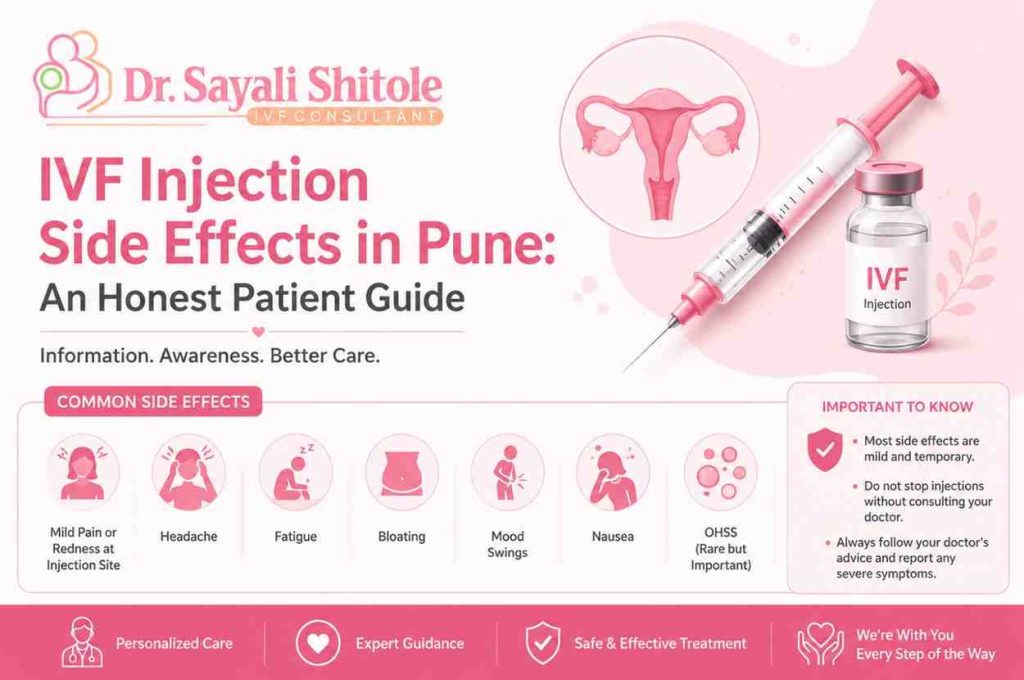
| Key Takeaways Most IVF injection side effects are mild and temporary: bloating, injection site reactions and mood changes.Ovarian Hyperstimulation Syndrome (OHSS) affects 1-5% of stimulated cycles and ranges from mild to severe.PCOS patients have the highest OHSS risk and are best managed with a freeze-all strategy.According to ICMR, most mild side effects resolve within 2 weeks of the last injection regardless of outcome.Headache and hot flushes are common with GnRH agonist suppression injections used in long protocols.Knowing which symptoms are normal versus which require a clinic call reduces unnecessary anxiety.Severe OHSS (under 1% of cycles) requires hospitalisation and is managed by stopping the fresh transfer and freezing embryos. |
| 10-20% of stimulated cycles Moderate-severe OHSS incidence: 1-5% of stimulated cycles OHSS highest risk group: PCOS, high AFC, young age, low BMI Side effect onset: Days 5-7 of stimulation Side effect resolution: Within 1-2 weeks of last injection Emergency OHSS sign: Breathlessness + abdominal distension |
IVF Injection Side Effects – Incidence Data 2025-2026
| Side Effect | Incidence | When It Occurs | Action Required |
| Injection site redness/bruising | Very common (50-70%) | After each injection | Rotate sites, ice if needed |
| Mild abdominal bloating | Common (40-60%) | Days 6-14 of stimulation | Loose clothing, hydration |
| Mood changes/emotional sensitivity | Common (40-50%) | Throughout stimulation | Counselling support, partner awareness |
| Fatigue | Common (30-40%) | Mid to late stimulation | Rest, reduce non-essential activities |
| Headache | Moderate (20-30%) | GnRH agonist phase | Paracetamol if needed (doctor-approved) |
| Hot flushes | Moderate (15-25%) | GnRH agonist phase | Lightweight clothing, cooling measures |
| Mild nausea | Less common (10-15%) | Early stimulation | Small frequent meals |
| Mild OHSS | Common (10-20%) | Post-trigger, post-retrieval | Hydration, rest, monitor weight daily |
| Moderate-severe OHSS | Uncommon (1-5%) | 5-10 days post-trigger | Clinic contact immediately |
Understanding Why IVF Injections Cause Side Effects
IVF stimulation injections contain follicle-stimulating hormone (FSH) and sometimes luteinising hormone (LH) analogues. These are synthetic versions of the hormones your body produces naturally but in much higher doses. The goal is to stimulate multiple follicles to grow simultaneously instead of the single dominant follicle of a natural cycle.
The side effects are a direct result of these elevated hormone levels and the ovarian response to them. As follicles grow, oestrogen levels rise significantly, sometimes to 5-10 times their normal peak. This hormonal environment is responsible for most of what patients experience during stimulation. It’s uncomfortable but purposeful.
Injection Site Reactions: What to Expect
1. Subcutaneous (under the skin) injections are given into the lower abdomen or the upper outer thigh. Some redness, mild bruising and tenderness at injection sites are normal. These occur because the needle puncture and the medication itself cause a minor local reaction.
2. To minimise injection site reactions: rotate the injection site by at least 2 cm from the previous day’s injection. Let the medication warm to room temperature for 5-10 minutes before injecting (cold medications cause more stinging). Pinch the skin gently before injection. Apply a cold compress afterwards if there’s significant redness.
3. A small hard lump under the skin after injection is usually a normal subcutaneous reaction and resolves in a few days. A warm red area larger than 2 cm that worsens over 24 hours should be shown to your clinic as it may indicate a mild infection.
Managing Bloating and Abdominal Discomfort
Bloating is the most universally reported side effect of IVF stimulation. As follicles grow, the ovaries enlarge. An unstimulated ovary is about the size of a walnut. By Day 10-12 of stimulation with 10-15 growing follicles, each ovary can be the size of a tangerine. This enlargement, multiplied by two ovaries, causes a distinct sense of fullness and pressure in the lower abdomen.
Practical management: wear loose, comfortable clothing (swapping fitted jeans for loose kurtas or leggings is widely reported as the best lifestyle change during stimulation). Avoid carbonated drinks, which worsen bloating. Eat smaller meals more frequently. Avoid heavy exercise which jostles the enlarged ovaries.
After egg retrieval, bloating typically worsens for 24-48 hours as the body responds to follicle aspiration, then gradually improves. By Day 5-7 post retrieval, most patients are significantly more comfortable.
Ovarian Hyperstimulation Syndrome (OHSS): Know the Signs
| OHSS Grade | Symptoms | Management | Who Is at Risk |
| Mild OHSS | Bloating, mild abdominal pain, slight weight gain | Rest, hydration, monitor weight daily | 10-20% of all stimulated cycles |
| Moderate OHSS | Worsening pain, nausea/vomiting, noticeable abdominal distension, weight gain over 2kg in 24h | Clinic assessment, IV fluids if needed, freeze-all strategy | 3-5% of all cycles |
| Severe OHSS | Marked distension, breathlessness, reduced urine output, severe pain | Hospitalisation, IV fluids, anticoagulation | Under 1% of cycles |
| Critical OHSS | Thrombosis risk, kidney impairment, respiratory compromise | ICU level care | Very rare, requires aggressive management |
Mood Changes: The Side Effect Nobody Warns You About Enough
The emotional turbulence of an IVF cycle is not purely psychological stress. The hormonal changes during stimulation, particularly the rising oestrogen and the subsequent progesterone support, directly affect neurotransmitters. Many women describe an emotional sensitivity that feels disproportionate to circumstances: crying at an advertisement, snapping at a partner over something trivial, swinging between hope and despair in the same afternoon.
Your partner should know this is physiological, not personal. For men accompanying their partners through IVF, the phrase ‘it’s the hormones’ is not dismissive. It’s accurate. The kindest response is practical support: take over domestic tasks during stimulation, don’t take emotional reactions personally and be reliably present.
If mood changes are severe, persistent or accompanied by thoughts of self-harm at any point, contact your clinic. Referral to a fertility counsellor can provide meaningful support through this phase.
IVF Side Effect Management in Pune: Practical Support
Femcare Fertility in Kalyani Nagar, where Dr. Sayali Shitole Chavan practises, provides all IVF patients with a printed side effect guide before starting their cycle. The guide distinguishes between expected side effects and warning signs that require an immediate call to the IVF coordinator.
The clinic’s WhatsApp-based check-in system during stimulation allows patients to report symptoms and receive guidance without unnecessary travel to the clinic. Monitoring scans already scheduled every 2-3 days give the clinical team regular opportunities to assess OHSS risk and adjust the protocol.
Frequently Asked Questions
Q: Are IVF injections very painful?
A: Most patients rate the discomfort at 2-3 out of 10. The needles are very fine and the injections are subcutaneous (not intramuscular). The main discomfort is a brief sting at injection and mild site soreness afterwards. The anxiety before the first injection is usually worse than the injection itself. Your nurse will train you before you do it independently.
Q: Can IVF injections cause long-term hormonal damage?
A: No credible evidence supports this concern. The hormones used in IVF stimulation are identical to naturally occurring hormones and are cleared from the body within days of stopping injections. Long-term studies following IVF patients for 20+ years show no elevated risk of hormonal disorders attributable to IVF stimulation medications.
Q: I have PCOS. Am I definitely going to get OHSS?
A: PCOS increases OHSS risk but does not make it inevitable. With careful protocol design (low starting doses, frequent monitoring, trigger modification) and a freeze-all strategy where appropriate, PCOS patients can complete IVF cycles safely. Dr. Sayali’s PCOS-specific protocols are designed specifically to manage this risk proactively.
Q: When should I call the clinic during stimulation?
A: Call immediately if you gain over 2 kg in a 24-hour period (fluid retention sign), experience severe abdominal pain that doesn’t respond to paracetamol, notice reduced urination, or feel breathlessness or chest tightness. For mild bloating, tenderness or mood changes, note them to mention at your next scheduled scan visit.
Q: Do the injections affect the quality of eggs produced?
A: The injections stimulate the development of follicles that were already in your ovarian pool. They don’t create new eggs or damage existing ones. The quality of eggs produced depends primarily on your age and individual egg quality, not on the medications used to grow them. Correct stimulation doses improve the number of mature eggs available without compromising their quality.
Conclusion
IVF injection side effects in Pune are real but manageable. Understanding what is normal, what needs monitoring and what requires an urgent call takes the fear out of the stimulation phase. The discomfort is temporary. The potential outcome is a family.
Dr. Sayali Shitole Chavan at Femcare Fertility, Kalyani Nagar, ensures every patient enters their stimulation cycle with complete, honest information about what to expect and clear guidance on when to seek help.
Start your IVF cycle prepared and informed.
Book a consultation at drsayalichavanivfdoctor

Dr. Sayali Chavan - Shitole
Dr. Sayali Shitole IVF & Fertility Specialist in Pune is a reliable and among the IVF Clinic in Pune & IVF Centre in Pune. Dr. Sayali Shitole is equipped with all ultra-modern facilities IVF Clinic/IVF Centre and Test Tube Baby Centre in Pune.