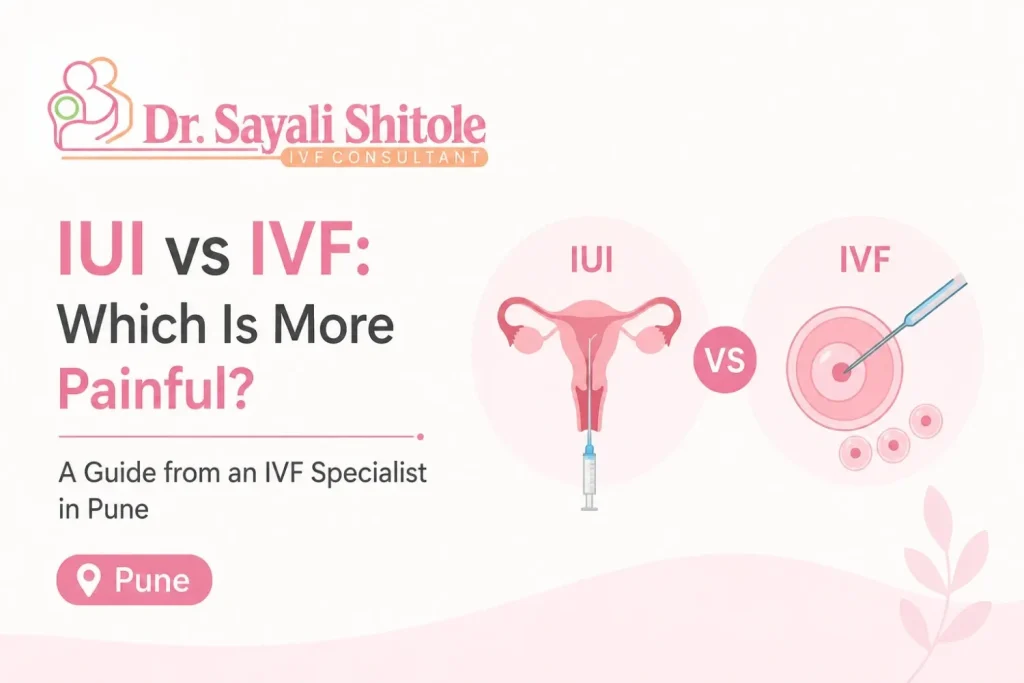
IVF generally involves more discomfort than IUI because it includes daily stimulation injections and a minor egg retrieval procedure, while IUI is a quick, largely painless procedure similar to a Pap smear. Both are manageable with standard pain relief. Femcare Fertility, led by Dr. Sayali Chavan Shitole, an experienced IVF specialist in Pune, offers both IUI and IVF treatments under one roof.
Pain is one of the first questions couples ask when comparing IUI and IVF, often even before they ask about success rates. It is a fair question. Fertility treatment already carries emotional weight, and nobody wants to walk into a procedure blind to what their body will feel. This guide breaks down what each treatment actually involves, stage by stage, what causes the discomfort, how long it lasts, and how it is managed, so you can go into your first appointment with realistic expectations rather than guesswork.
It helps to separate two different questions that often get mixed together: how much a procedure hurts, and how much a treatment cycle demands from your body overall. IUI answers the first question quickly, since it is a single short procedure. IVF is a longer process with several stages, so its overall physical demand is higher even though no single step is severely painful for most patients.
IUI vs IVF: A Quick Overview
Intrauterine insemination (IUI) and in vitro fertilisation (IVF) are both fertility treatments, but they work very differently and involve very different levels of physical involvement.
- IUI Treatment : Washed and concentrated sperm is placed directly into the uterus around the time of ovulation, using a thin catheter. It takes a few minutes and needs no anaesthesia.
- IVF Treatment : Eggs are stimulated with daily injections, retrieved in a minor surgical procedure under sedation, fertilised in a lab, and the resulting embryo is transferred back into the uterus.
Because IVF involves several distinct stages and IUI involves essentially one, the two cannot be compared as a single pain score. Each stage needs to be looked at on its own.
Is IUI Painful? What to Expect
Most patients describe IUI as mildly uncomfortable rather than painful. The procedure itself takes three to five minutes and is done without sedation, in a normal outpatient visit.
- Speculum insertion: Similar sensation to a routine gynaecological exam or Pap smear.
- Catheter placement: A thin, flexible catheter is passed through the cervix, which can cause brief cramping, especially if the cervix is naturally narrow or tilted.
- After the procedure: Some women feel light cramping or spotting for a few hours, similar to mild period pain.
If IUI is combined with ovulation-stimulating medication, the injections used before the procedure can cause a mild pinching sensation, but this is separate from the IUI procedure itself and is far less intense than IVF stimulation.
Is IVF Painful? A Stage-by-Stage Breakdown
IVF involves more steps, and each one carries a different type and intensity of discomfort.
Stage 1: Ovarian stimulation injections
Daily hormone injections are given under the skin, usually in the abdomen, for around ten to twelve days. Most patients describe this as a brief pinch or sting rather than significant pain. Bruising and mild bloating are more common complaints than sharp pain.
Stage 2: Monitoring visits
Blood tests and transvaginal ultrasound scans are used to track follicle growth. These are quick and generally not painful, though the ultrasound probe can feel slightly uncomfortable for some patients.
Stage 3: Egg retrieval
This is usually the stage patients worry about most. Egg retrieval is done under light sedation or local anaesthesia, so patients do not feel the procedure itself. After the sedation wears off, mild cramping, bloating and pelvic soreness are common for a day or two, comparable to strong period cramps.
Stage 4: Embryo transfer
Embryo transfer does not need anaesthesia. It is similar to a Pap smear or IUI in terms of sensation, involving a thin catheter passed through the cervix. Most patients rate it as mildly uncomfortable rather than painful.
Stage 5: The two-week wait
Some women experience mild cramping or bloating during this period due to the hormonal medication used to support the uterine lining, rather than the procedures themselves.
What Actually Causes the Discomfort
Understanding the source of discomfort makes it easier to know what is normal and what needs a call to your clinic.
- Needle injections: The sting comes from the needle passing through skin and, briefly, from the medication itself. Rotating injection sites and using the correct needle length reduces this.
- Catheter procedures: Mild cramping during IUI and embryo transfer usually comes from the catheter passing through the cervix, which is naturally sensitive. A tilted or narrow cervix can make this slightly more noticeable.
- Ovarian enlargement: During stimulation, the ovaries grow larger than usual to support multiple follicles. This can cause a heavy, bloated feeling rather than sharp pain.
- Egg retrieval: The needle used to collect eggs passes through the vaginal wall into the ovaries. Sedation prevents pain during the procedure, and post-procedure soreness comes from the ovaries settling back down afterward.
None of these causes are dangerous on their own. Severe or one-sided pain, heavy bleeding, fever, or difficulty breathing after any procedure should always be reported to your clinic immediately, since these can be signs of a complication that needs prompt attention.
Pain Comparison Table: IUI vs IVF
| Stage | IUI Treatment | IVF Treatment |
| Medication | Mild, occasional stimulation injections | Daily stimulation injections for about 10 to 12 days |
| Main procedure | Catheter insertion, 3 to 5 minutes, no sedation | Egg retrieval under sedation, 15 to 20 minutes |
| Anaesthesia needed | No | Yes, for egg retrieval only |
| Recovery discomfort | Light cramping for a few hours | Bloating and cramping for one to two days after retrieval |
| Overall pain level | Low | Low to moderate, concentrated around retrieval |
Factors That Affect How Much Pain You Feel
- Individual pain tolerance and anxiety levels around medical procedures
- Underlying conditions such as endometriosis or PCOS, which can increase sensitivity
- The skill and experience of the clinical team performing the procedure
- Whether the cervix is easily accessible or requires extra manipulation during catheter placement
- The dose and type of stimulation medication used
- Ovarian hyperstimulation syndrome (OHSS), an uncommon but more painful reaction to stimulation medication that needs medical attention if it occurs
Pain Management Options During IUI and IVF
- Over-the-counter pain relief such as paracetamol, taken as advised by your doctor, for mild cramping
- Sedation or local anaesthesia during IVF egg retrieval, so the procedure itself is not felt
- Relaxation techniques and slow breathing during catheter-based procedures to ease muscle tension
- A full bladder protocol before embryo transfer, which many clinics use to straighten the uterus and ease catheter passage
- Rest and a heating pad for post-retrieval bloating and cramping, as advised by your clinical team
Recovery Timeline: How Long Discomfort Lasts
Knowing the expected timeline helps you tell the difference between normal recovery and something worth flagging to your doctor.
| Procedure | Typical Discomfort Window | When to Call Your Doctor |
| IUI procedure | A few hours, mild cramping only | Heavy bleeding or fever |
| Stimulation injections | Brief sting at injection, resolves within minutes | Redness, swelling or severe bruising at the site |
| Egg retrieval | One to two days of bloating and cramping | Severe abdominal pain, rapid weight gain or breathlessness, which may indicate OHSS |
| Embryo transfer | A few hours of mild cramping at most | Sharp pain or heavy bleeding |
Which Treatment Is Right for You? We Offer Both, Under One Roof
The choice between IUI and IVF is not only about pain. It depends on your age, the cause of infertility, how long you have been trying to conceive, and prior treatment history. IUI is usually recommended first for mild male-factor infertility, unexplained infertility, or ovulation issues, while IVF is recommended for blocked fallopian tubes, severe male-factor infertility, advanced maternal age, or after IUI cycles have not worked.
Femcare Fertility provides both IUI and IVF treatment under one roof, so couples do not need to switch clinics if their treatment plan changes. Dr. Sayali Chavan Shitole evaluates each case individually and recommends the option that fits your specific diagnosis, rather than defaulting to one treatment for every patient.
Why Consult an Experienced IVF Specialist in Pune
Pain, success rates and treatment planning are all connected to the skill of the clinical team. An experienced IVF specialist in Pune reduces unnecessary discomfort by using correct catheter technique, appropriate sedation protocols and individualised stimulation doses. Dr. Sayali Chavan Shitole at Femcare Fertility, Kalyani Nagar, brings this experience to every IUI and IVF cycle, with treatment plans built around each patient’s diagnosis rather than a one-size-fits-all protocol.
Frequently Asked Questions
Q1. Is IUI more painful than IVF?
No, IUI is generally less painful than IVF overall. IUI is a single quick procedure with no sedation, while IVF includes daily injections and a minor surgical retrieval, though the retrieval itself is done under sedation so it is not felt at the time.
Q2. Does egg retrieval in IVF hurt?
Egg retrieval is performed under sedation or local anaesthesia, so patients do not feel pain during the procedure. Mild cramping and bloating are common for a day or two afterward.
Q3. Are IVF injections painful?
Most patients describe IVF stimulation injections as a brief sting or pinch rather than significant pain. Site rotation and proper technique reduce bruising and discomfort.
Q4. How can I reduce pain during embryo transfer?
Embryo transfer does not need anaesthesia and is usually mildly uncomfortable rather than painful. Relaxing the pelvic muscles, following the full bladder protocol if advised, and staying calm during the procedure all help reduce discomfort.
Q5. Should I choose IUI or IVF for my treatment plan?
This depends on your diagnosis, age and treatment history rather than pain alone. An IVF specialist in Pune can assess your case and recommend IUI, IVF or a combination approach based on what is most likely to succeed for you.
Q6. Can the same clinic provide both IUI and IVF treatment?
Yes. Femcare Fertility offers both IUI and IVF under one roof, so your treatment plan can move from one option to the other without changing clinics if your doctor recommends it.
Q7. What is OHSS and how painful is it?
Ovarian hyperstimulation syndrome (OHSS) is an uncommon reaction to stimulation medication where the ovaries become swollen and painful. Mild cases cause bloating and discomfort, while moderate to severe cases need medical attention. Your clinic monitors follicle growth and hormone levels closely to reduce this risk.
Q8. How many IUI or IVF cycles are typically needed?
This varies by individual diagnosis and age. Some patients conceive in the first cycle, while others need multiple attempts. Your IVF specialist in Pune will review your response after each cycle and adjust the plan accordingly rather than repeating the same protocol automatically.
Consult an IVF Specialist in Pune for a Personalised Plan
Whether IUI or IVF is right for you depends on your specific diagnosis. Book a consultation with Dr. Sayali Chavan Shitole at Femcare Fertility, Kalyani Nagar, Pune. We provide both IUI and IVF treatment under one roof, with a plan built around your individual case.
Call : 7972996874
WhatsApp to schedule your first appointment

Dr. Sayali Chavan - Shitole
Dr. Sayali Shitole Best IVF & Fertility Specialist in Pune is a reliable and among the Best IVF Clinic in Pune & IVF Centre in Pune. Dr. Sayali Shitole is equipped with all ultra-modern facilities IVF Clinic/IVF Centre and Test Tube Baby Centre in Pune.