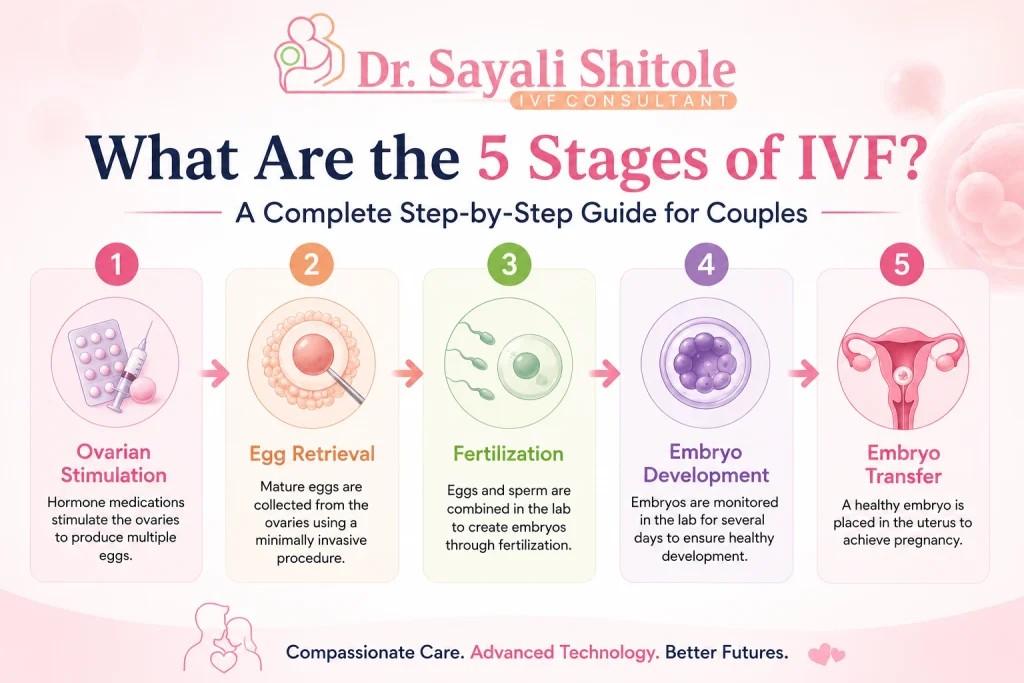
Infertility can be an emotional and challenging journey for couples who dream of starting a family. Fortunately, advances in reproductive medicine have made it possible for many individuals to achieve pregnancy through In Vitro Fertilization (IVF). One of the most common questions asked by patients is, “What are the 5 stages of IVF?”
Understanding each stage of the IVF process can help reduce anxiety, set realistic expectations, and prepare you for the journey ahead. IVF is not a single procedure but a series of carefully planned steps designed to maximize the chances of a successful pregnancy.
In this comprehensive guide, we’ll explain the 5 stages of IVF treatment, how long each stage takes, what to expect during the process, and factors that can influence IVF success.
Quick Answer: What Are the 5 Stages of IVF?
The IVF process consists of five main stages:
| IVF Stage | Purpose | Approximate Duration |
|---|---|---|
| Ovarian Stimulation | Stimulate the ovaries to produce multiple eggs | 8–14 Days |
| Egg Retrieval | Collect mature eggs from the ovaries | 1 Day |
| Fertilization & Embryo Development | Fertilize eggs and grow embryos in a laboratory | 3–5 Days |
| Embryo Transfer | Transfer a healthy embryo into the uterus | 1 Day |
| Pregnancy Test | Confirm implantation and pregnancy | 10–14 Days After Transfer |
Each stage plays a crucial role in helping couples achieve a successful pregnancy through IVF treatment.
Understanding IVF Treatment Before Starting
What Is IVF?
In Vitro Fertilization (IVF) is an advanced fertility treatment in which eggs are retrieved from a woman’s ovaries and fertilized with sperm in a specialized laboratory. The resulting embryo is then transferred into the uterus with the goal of achieving pregnancy.
IVF is one of the most effective forms of assisted reproductive technology (ART) and has helped millions of couples worldwide build their families.
Who Can Benefit from IVF?
IVF may be recommended for individuals or couples facing:
- Blocked or damaged fallopian tubes
- Male infertility factors
- Ovulation disorders
- Endometriosis
- Unexplained infertility
- Advanced maternal age
- Recurrent pregnancy loss
- Genetic disorders requiring embryo screening
Stage 1 – Ovarian Stimulation
The first stage of IVF is known as ovarian stimulation or controlled ovarian hyperstimulation.
Why Is Ovarian Stimulation Necessary?
In a natural menstrual cycle, a woman typically releases only one egg. During IVF, fertility medications are used to encourage the ovaries to produce multiple mature eggs.
Having multiple eggs increases the chances of creating healthy embryos and achieving pregnancy.
How Fertility Medications Work
Patients are prescribed hormone injections that stimulate follicle development within the ovaries.
Common medications may include:
| Medication Type | Purpose |
|---|---|
| FSH Injections | Stimulate egg production |
| LH Hormones | Support follicle development |
| GnRH Antagonists | Prevent premature ovulation |
| Trigger Shot | Final egg maturation |
Monitoring During Stimulation
Regular monitoring is essential during this stage.
Your fertility specialist will use:
- Transvaginal ultrasounds
- Blood hormone tests
- Follicle measurements
These tests help determine when the eggs are ready for retrieval.
Duration of Stage 1
Most women undergo ovarian stimulation for approximately 8 to 14 days.
Stage 2 – Egg Retrieval Procedure
Once the follicles reach the desired size, the next stage is egg retrieval.
What Is Egg Retrieval?
Egg retrieval is a minor surgical procedure used to collect mature eggs from the ovaries.
The procedure is usually performed under light sedation to ensure patient comfort.
How the Procedure Is Performed
During egg retrieval:
- A thin ultrasound-guided needle is inserted through the vaginal wall.
- Follicular fluid containing eggs is collected.
- The fluid is examined in the laboratory.
- Mature eggs are identified and prepared for fertilization.
Is Egg Retrieval Painful?
Most women experience little to no pain during the procedure because sedation is administered.
Some mild symptoms afterward may include:
- Cramping
- Bloating
- Mild spotting
- Pelvic discomfort
These symptoms generally resolve within a few days.
Recovery Time
Most patients return home within a few hours and resume normal activities the following day.
Egg Retrieval Timeline
| Step | Duration |
|---|---|
| Procedure | 20–30 Minutes |
| Recovery Room | 1–2 Hours |
| Return Home | Same Day |
Stage 3 – Fertilization and Embryo Development
After egg retrieval, the fertilization process begins in the IVF laboratory.
How Fertilization Occurs
The collected eggs are combined with sperm from the male partner or donor.
Fertilization can occur through:
Conventional IVF
Healthy sperm are placed around the egg, allowing natural fertilization.
ICSI (Intracytoplasmic Sperm Injection)
A single sperm is directly injected into an egg.
ICSI is commonly recommended for male infertility cases.
Embryo Development
Successfully fertilized eggs become embryos.
Embryologists monitor embryo growth daily.
Embryo Growth Timeline
| Day | Development Stage |
|---|---|
| Day 1 | Fertilization Confirmation |
| Day 2 | 2–4 Cell Embryo |
| Day 3 | 6–8 Cell Embryo |
| Day 4 | Morula Stage |
| Day 5–6 | Blastocyst Stage |
Why Blastocysts Are Important
A blastocyst is a more advanced embryo with a higher implantation potential.
Many fertility clinics prefer transferring blastocysts because they often result in better pregnancy outcomes.
Stage 4 – Embryo Transfer
The fourth stage of IVF is embryo transfer.
What Happens During Embryo Transfer?
The selected embryo is placed into the uterus using a thin catheter.
The procedure is simple, painless, and usually does not require anesthesia.
Fresh vs Frozen Embryo Transfer
Fresh Embryo Transfer
Performed within the same IVF cycle.
Frozen Embryo Transfer (FET)
Embryos are frozen and transferred later when the uterine lining is optimal.
Many clinics report excellent success rates with frozen embryo transfers.
After the Transfer
Patients are advised to:
- Continue prescribed medications
- Stay hydrated
- Avoid strenuous activities
- Follow medical instructions carefully
Contrary to common belief, strict bed rest is generally not required.
Stage 5 – Pregnancy Test and Early Monitoring
The final stage of IVF is pregnancy testing.
When Is the Pregnancy Test Performed?
A blood test called Beta hCG is usually performed 10–14 days after embryo transfer.
This test measures pregnancy hormone levels and provides an accurate result.
Understanding Beta hCG
Higher hormone levels generally indicate successful implantation.
However, the exact value varies among individuals.
What Happens After a Positive Test?
If pregnancy is confirmed:
- Repeat blood tests may be scheduled.
- Ultrasound scans monitor fetal development.
- Fertility medications may continue for several weeks.
If IVF Is Unsuccessful
Not every IVF cycle results in pregnancy.
Your fertility specialist may review:
- Embryo quality
- Egg quality
- Uterine factors
- Treatment protocol adjustments
Many couples achieve success in subsequent IVF cycles.
IVF Timeline at a Glance
| Day | Procedure |
|---|---|
| Day 1–14 | Ovarian Stimulation |
| Day 14 | Trigger Injection |
| Day 15–16 | Egg Retrieval |
| Day 16–21 | Fertilization & Embryo Growth |
| Day 21 | Embryo Transfer |
| Day 31–35 | Pregnancy Test |
The complete IVF cycle generally takes about 4 to 6 weeks.
Factors That Affect IVF Success Rates
Several factors influence the outcome of IVF treatment.
Female Age
Age remains one of the strongest predictors of IVF success.
IVF Success Rates by Age
| Age Group | Average Success Rate |
|---|---|
| Under 35 Years | 50–60% |
| 35–37 Years | 40–50% |
| 38–40 Years | 25–40% |
| Above 40 Years | 10–20% |
Egg Quality
Healthy eggs increase fertilization and embryo development rates.
Sperm Quality
Sperm count, motility, and morphology affect fertilization outcomes.
Embryo Quality
High-quality embryos have a greater chance of implantation.
Uterine Health
A healthy uterine lining is essential for embryo implantation.
Lifestyle Factors
Lifestyle choices can significantly impact IVF success.
Positive habits include:
- Healthy eating
- Regular exercise
- Adequate sleep
- Stress management
Common Side Effects During IVF Treatment
Most IVF side effects are temporary and manageable.
Common Symptoms
- Bloating
- Mild pelvic pain
- Breast tenderness
- Mood swings
- Fatigue
- Headaches
When to Contact Your Doctor
Seek medical attention if you experience:
- Severe abdominal pain
- Rapid weight gain
- Breathing difficulty
- Excessive swelling
These may indicate ovarian hyperstimulation syndrome (OHSS).
Tips to Improve IVF Success
Although no method guarantees pregnancy, certain lifestyle changes may support treatment outcomes.
Follow Your Medication Schedule
Take medications exactly as prescribed.
Maintain a Healthy Weight
Both underweight and overweight individuals may experience lower success rates.
Eat a Balanced Diet
Focus on:
- Fresh fruits
- Vegetables
- Lean proteins
- Whole grains
- Healthy fats
Avoid Smoking and Alcohol
Smoking and excessive alcohol consumption can negatively affect fertility.
Manage Stress
Relaxation techniques may help improve emotional well-being during treatment.
Consider:
- Meditation
- Yoga
- Counseling
- Support groups
The Emotional Journey Through the 5 Stages of IVF
IVF is not only a physical process but also an emotional one.
Many couples experience:
- Hope
- Anxiety
- Excitement
- Uncertainty
Having realistic expectations and a strong support system can make the journey more manageable.
Professional fertility counseling may also provide emotional support during treatment.
Frequently Asked Questions (People Also Ask)
1. What are the 5 stages of IVF treatment?
The five stages of IVF include ovarian stimulation, egg retrieval, fertilization and embryo development, embryo transfer, and pregnancy testing.
2. How long do the 5 stages of IVF take?
A complete IVF cycle usually takes approximately 4–6 weeks from ovarian stimulation to pregnancy testing.
3. Which stage of IVF is the most difficult?
Many patients find the waiting period between embryo transfer and pregnancy testing emotionally challenging.
4. Is IVF painful?
Most IVF procedures involve minimal discomfort. Egg retrieval is performed under sedation, and embryo transfer is generally painless.
5. What is the success rate of IVF on the first attempt?
Success rates vary depending on age, fertility diagnosis, embryo quality, and overall health.
6. Can IVF fail after embryo transfer?
Yes. Even after embryo transfer, implantation may not occur. Multiple factors influence successful implantation.
7. How many eggs are usually collected during IVF?
The number varies, but many patients produce between 8 and 15 eggs during an IVF cycle.
8. What should I avoid during IVF treatment?
Avoid smoking, alcohol, recreational drugs, and excessive physical exertion unless approved by your doctor.
9. How soon can I take a pregnancy test after IVF?
A blood pregnancy test is usually performed 10–14 days after embryo transfer.
10. Can I work during IVF treatment?
Most patients can continue normal work activities throughout treatment, although individual circumstances may vary.
Conclusion
Understanding what are the 5 stages of IVF can help couples feel more informed and confident throughout their fertility journey. The IVF process includes ovarian stimulation, egg retrieval, fertilization, embryo transfer, and pregnancy testing. Each stage is carefully designed to maximize the chances of a successful pregnancy.
While IVF can feel overwhelming at times, advances in reproductive medicine continue to improve outcomes for couples facing infertility. Working with an experienced fertility specialist, maintaining a healthy lifestyle, and following your treatment plan can help optimize your chances of success.
Take the Next Step Toward Parenthood
If you are struggling with infertility or considering IVF treatment, consulting an experienced fertility specialist can help you understand your options and create a personalized treatment plan.

Dr. Sayali Chavan - Shitole
Dr. Sayali Shitole Best IVF & Fertility Specialist in Pune is a reliable and among the Best IVF Clinic in Pune & IVF Centre in Pune. Dr. Sayali Shitole is equipped with all ultra-modern facilities IVF Clinic/IVF Centre and Test Tube Baby Centre in Pune.