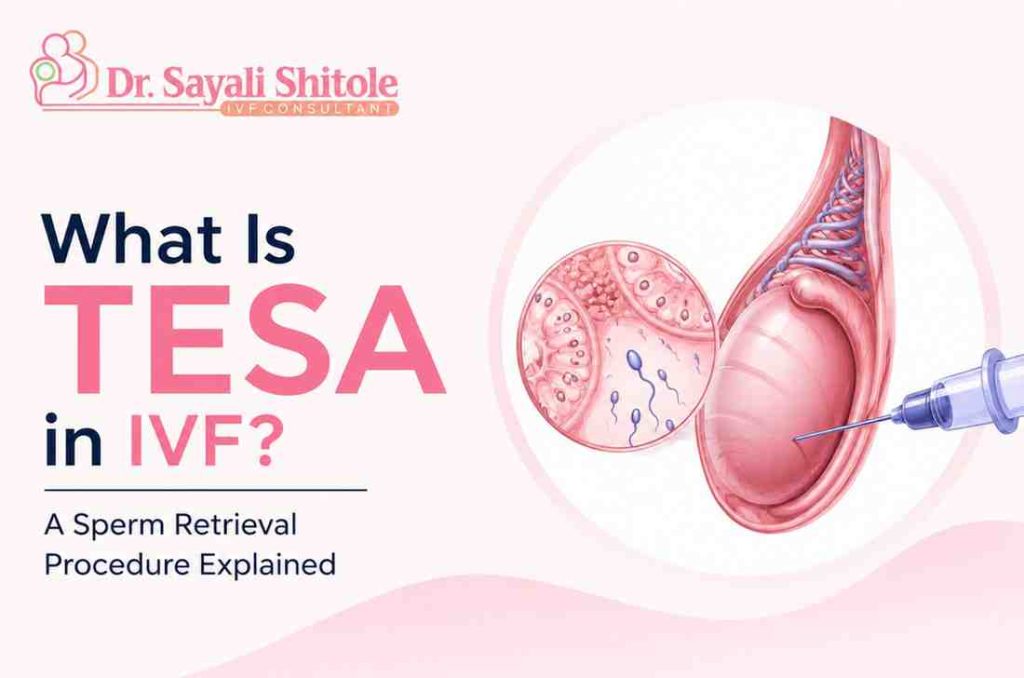
TESA, or testicular sperm aspiration, is a minor surgical procedure used in IVF to collect sperm directly from the testicle when none is found in a man’s ejaculate. I use it along with ICSI to help couples with male infertility conceive, even in cases of azoospermia.
Key Takeaways
- TESA retrieves sperm straight from testicular tissue when the ejaculate contains none.
- It is recommended mainly for men with obstructive or non-obstructive azoospermia.
- The procedure takes about 20 to 30 minutes and is usually done under local anaesthesia.
- Sperm collected through TESA is used the same day with ICSI to fertilise the eggs.
- Recovery is quick for most men, with mild soreness settling within two to three days.
| Aspect | Detail |
| Full form | Testicular Sperm Aspiration |
| Type of procedure | Minor surgical, needle-based sperm retrieval |
| Anaesthesia | Local anaesthesia, occasionally with light sedation |
| Duration | 20 to 30 minutes |
| Used with | ICSI (Intracytoplasmic Sperm Injection) |
| Recovery time | 2 to 3 days for routine activity |
| Hospital stay | Day-care procedure, no overnight admission needed |
| Statistic | Figure | Source |
| Men affected by azoospermia in the general population | About 1 in 100 men | Industry estimate |
| Infertile men found to have azoospermia on evaluation | 10 to 15 out of every 100 | Industry estimate |
| Cases where sperm can still be retrieved surgically | Majority of obstructive azoospermia cases | Industry estimate |
Over the years at Femcare Fertility in Kalyani Nagar, I have met many couples who come to me after their semen analysis report reads “no sperm found.” I understand how frightening those three words can feel. But this is often not the end of the road. In a large number of these cases, sperm is still present inside the testicle, simply not making it into the ejaculate. TESA is one of the ways I retrieve that sperm directly, so we can move ahead with IVF.
What Does TESA in IVF Actually Involve
TESA stands for testicular sperm aspiration. During the procedure, I insert a fine needle through the skin of the scrotum into the testicle and gently draw out a small sample of tissue and fluid using suction. Our embryology team then examines this sample under a microscope to look for sperm. If sperm is found, it is used the same day to fertilise the eggs retrieved from the female partner through ICSI, where a single sperm is injected directly into each mature egg.
I usually recommend TESA on the same day as the female partner’s egg retrieval, so the timing works in favour of using fresh sperm. In some cases, when we want to plan ahead or confirm sperm presence before starting an IVF cycle, I do it separately and freeze the sample for later use.
Understanding Azoospermia: Why Some Men Have No Sperm in Their Ejaculate
Azoospermia simply means no sperm is detected in the semen. I explain it to my patients as falling into two broad categories.
Obstructive azoospermia
The testicle is producing sperm normally, but a blockage somewhere in the reproductive tract, often in the vas deferens or epididymis, stops it from reaching the ejaculate. This can follow an infection, a previous surgery, a vasectomy, or in some men, a condition they were born with.
Non-obstructive azoospermia
Here, the testicle itself produces very little or no sperm. This is usually linked to a hormonal imbalance, a genetic factor, or testicular damage from a past illness or injury. TESA can still succeed in some of these cases, since sperm production is often patchy rather than completely absent.
How I Perform TESA Step by Step
- I begin with a local anaesthetic injection to numb the scrotal area completely.
- A fine needle is passed into the testicle, and gentle suction draws out a small tissue and fluid sample.
- The sample goes straight to our embryology lab, where it is checked for sperm under magnification.
- If needed, I repeat the aspiration at a slightly different point in the same testicle, or the opposite testicle, to improve the chance of finding sperm.
- Once sperm is confirmed, we proceed with ICSI, or the sample is frozen for a future cycle.
- A small dressing is placed over the site, and the patient rests for a short while before going home the same day.
TESA Compared to Other Sperm Retrieval Methods
Couples often ask me why I choose TESA over other retrieval techniques. The right method depends on the cause of azoospermia and what we find on evaluation.
| Procedure | Best suited for | Anaesthesia | How sperm is retrieved |
| TESA | Obstructive azoospermia, quick retrieval needed | Local anaesthesia | Needle aspiration from the testicle |
| PESA | Obstructive azoospermia with a clearly blocked epididymis | Local anaesthesia | Needle aspiration from the epididymis |
| Micro-TESE | Non-obstructive azoospermia with very low sperm production | General or spinal anaesthesia | Microsurgical exploration of testicular tissue under a microscope |
I reserve micro-TESE for men where a straightforward TESA is unlikely to find sperm, since it lets us examine the testicular tissue far more closely under magnification.
What Happens After TESA: Combining It With ICSI
On the same day, while the sperm sample from TESA is being processed, our team collects and prepares the eggs retrieved from the female partner. Each mature egg is then injected with a single healthy sperm through ICSI. I keep both partners informed through this stage, since a lot happens within a few hours in the lab. Fertilisation is usually checked the next morning, and I discuss the results, along with the plan for embryo transfer, at that point.
Success Rates and What Affects Them
Couples always ask me what their chances look like. Sperm retrieval success with TESA is generally higher in obstructive azoospermia, since the testicle is producing sperm normally to begin with. In non-obstructive cases, success depends more on the underlying cause and how much residual sperm production remains. Once sperm is retrieved and used in ICSI, fertilisation and pregnancy rates depend on several factors beyond the sperm sample itself, including egg quality, the age of the female partner, and embryo development. I go through these factors individually with every couple before we begin, rather than quoting a single number that may not apply to their situation.
Risks and Recovery
TESA is a minor, well-tolerated procedure. Most of my patients feel mild soreness or slight swelling in the scrotal area for a day or two, which settles with rest and a supportive undergarment. I advise avoiding heavy exercise and sexual activity for about a week. Bleeding, infection, or lasting discomfort are uncommon when the procedure is performed under sterile conditions, but I ask every patient to reach out to me immediately if they notice unusual swelling, fever, or increasing pain.
Cost Considerations for TESA in Pune
The cost of TESA varies depending on whether it is combined with a fresh ICSI cycle, whether sperm freezing is required, and the anaesthesia used. Rather than quoting a fixed figure here, I go through a detailed cost breakdown during the consultation, once I understand a couple’s specific treatment plan. I believe couples deserve complete clarity on costs before they begin, not after.
TESA and Male Infertility Treatment at Femcare Fertility, Kalyani Nagar
I see couples for TESA and related male infertility treatments at Femcare Fertility in Kalyani Nagar, Pune. The clinic is easy to reach for patients travelling from Viman Nagar, Kharadi and Yerwada, and we coordinate the andrology and embryology steps of TESA and ICSI under one roof, so couples are not sent back and forth between different centres on the day of the procedure.
Frequently Asked Questions
1. Is TESA painful?
No. I perform TESA under local anaesthesia, so patients feel numbness rather than pain during the procedure itself. Mild soreness for a day or two afterward is normal.
2. Can TESA be done if I have had a vasectomy?
Yes. Vasectomy is one of the common causes of obstructive azoospermia, and TESA is often successful in retrieving sperm in these cases, since sperm production in the testicle is unaffected.
3. What if no sperm is found during TESA?
If TESA does not find sperm, I discuss further options with the couple, which may include micro-TESE, which examines testicular tissue more thoroughly, or the use of donor sperm, depending on what the couple is comfortable with.
4. Do I need to stay in hospital after TESA?
No. TESA is a day-care procedure. Patients rest at the clinic for a short while after the procedure and go home the same day.
5. Can TESA sperm be frozen for future use?
Yes. If sperm is retrieved before a planned IVF cycle, I can freeze it so it is ready whenever the female partner’s egg retrieval is scheduled.
6. How is TESA different from a testicular biopsy?
A biopsy removes a piece of tissue mainly to study it under a microscope for diagnosis. TESA is specifically aimed at retrieving usable sperm for that day’s or a future IVF cycle, though the two procedures can sometimes overlap.
Have Questions About TESA or Male Infertility Treatment?
I understand how overwhelming a diagnosis of azoospermia can feel. At Femcare Fertility, Kalyani Nagar, Pune, I walk every couple through their options in detail, from TESA and ICSI to the next steps, so you always know what to expect.

Dr. Sayali Chavan - Shitole
Dr. Sayali Shitole Best IVF & Fertility Specialist in Pune is a reliable and among the Best IVF Clinic in Pune & IVF Centre in Pune. Dr. Sayali Shitole is equipped with all ultra-modern facilities IVF Clinic/IVF Centre and Test Tube Baby Centre in Pune.