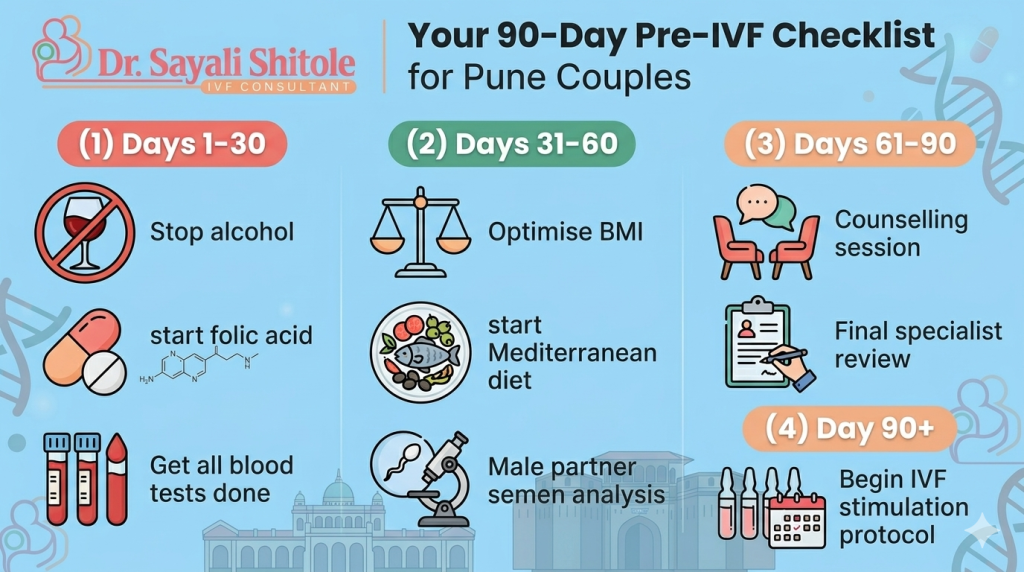
| Key Takeaways Starting IVF preparation at least 60-90 days before the first cycle improves success rates significantly.Folic acid supplementation (400-800 mcg daily) should begin at least 3 months before IVF.A healthy BMI between 18.5 and 24.9 improves ovarian stimulation response and embryo quality.Both partners need pre-IVF investigations. Male semen analysis is equally important as female tests.According to ICMR guidelines, ruling out thyroid disorders and vitamin D deficiency is mandatory before IVF.Reducing alcohol to zero and stopping smoking improves both egg and sperm quality.Psychological preparation through pre-IVF counselling reduces anxiety and improves treatment adherence. |
| Quick Facts Recommended preparation time: 60-90 days before first IVF cycle Folic acid dose: 400-800 mcg daily (or as prescribed) Target BMI for IVF: 18.5 to 24.9 Female pre-IVF tests: AMH, TSH, prolactin, FSH, LH, AFC, hysteroscopy Male pre-IVF test: Semen analysis, sperm DNA fragmentation Cost of pre-IVF workup Pune: INR 8,000 to INR 15,000 |
Pune IVF Preparation: Key Statistics 2025-2026
| Preparation Factor | Impact on IVF Success | Evidence Source |
| Healthy BMI (18.5-24.9) | Improves stimulation response by 15-20% | PubMed 2023 |
| Folic acid 3 months before | Reduces neural tube defect risk 70% | MoHFW India |
| Thyroid screening and treatment | Reduces miscarriage risk significantly | ICMR 2024 |
| Quitting alcohol 3 months before | Improves egg quality measurably | Indian J Medical Research |
| Male partner semen optimisation | Contributes to 40-50% of outcomes | WHO 2022 |
| Pre-IVF counselling | Reduces anxiety, improves compliance | PubMed 2022 |
| Vitamin D normalisation | Associated with higher implantation rates | Industry estimate |
Step 1: Complete Your Pre-IVF Investigations
Getting the right tests done before starting IVF is not optional. These results determine your protocol, medication doses and realistic expectations. For women, the essential tests are AMH (Anti-Mullerian Hormone), a Day 2 hormonal profile (FSH, LH, oestradiol), TSH for thyroid, prolactin, fasting glucose and a transvaginal ultrasound for antral follicle count.
A uterine cavity assessment is also needed. This is usually done via hysteroscopy or saline sonography to rule out polyps, fibroids or a septum that could affect implantation. Infectious disease screening for hepatitis B, hepatitis C and HIV is mandatory before ART procedures.
For men, a semen analysis done after 2-4 days of abstinence is the starting point. If parameters are borderline, sperm DNA fragmentation testing gives additional information about sperm health. The complete male workup costs INR 2,000-5,000 in Pune.
Step 2: Optimise Your Nutrition and Weight
Diet makes a real difference. A study in the Indian Journal of Medical Research found that women who consumed adequate zinc, selenium and omega-3 fatty acids in the three months before IVF showed improved oocyte quality. This isn’t about following a foreign diet. Indian staples like methi, spinach, moong dal, sesame seeds and groundnuts are rich in the exact micronutrients that support egg health.
Weight matters at both extremes. Women who are underweight (BMI below 18.5) often have poor ovarian response and irregular periods that complicate IVF timing. Women who are overweight (BMI above 27) frequently need higher medication doses and have lower implantation rates. A 5-10% weight loss over two to three months before IVF significantly improves outcomes for overweight women.
Avoid crash diets, which deplete micronutrients. Focus on real, whole foods. A nutritionist familiar with fertility preparation can help create an eating plan around Indian meals and seasonal Pune produce.
Step 3: Lifestyle Changes That Actually Work
Stop alcohol completely, not just reduce it. Studies show that even moderate alcohol consumption, defined as 4-7 units per week, is associated with a 16% reduction in IVF success rates in women. For men, alcohol affects sperm motility and morphology. If Diwali sweets and drinks are part of your social calendar, plan your IVF cycle around the festive season to avoid this conflict.
Stop smoking, including passive exposure. Nicotine affects blood supply to the ovaries and uterus, reduces ovarian reserve and lowers sperm quality. Both partners need to quit for at least 3 months before the IVF cycle begins.
Exercise moderately. High-intensity workouts like heavy weightlifting or marathon training during IVF stimulation are not recommended. Gentle walking for 30 minutes daily, swimming or yoga is ideal. Extreme exercise lowers oestrogen and can interfere with follicle development.
Step 4: Address Your Mental Preparation
Preparing emotionally for IVF is as important as physical preparation. The process is demanding. There are daily injections, frequent clinic visits, the two-week wait and the real possibility of a negative result. Couples who go in without psychological preparation often find the experience overwhelming.
Pre-IVF counselling helps couples align on expectations, discuss contingency plans (what if the first cycle fails?) and build communication strategies as a team. It’s not therapy in the traditional sense. It’s practical preparation for a medically intensive experience.
Meditation apps in Hindi and Marathi are available for free and can help manage the anxiety that comes with monitoring cycles. Keeping a small routine of enjoyable activities throughout the IVF process protects mental health during the months of treatment.
Step 5: Choose the Right Clinic and Build Your Support Network
Before starting IVF, visit at least one dedicated fertility clinic for a detailed consultation. Ask for the clinic’s own IVF success rate by age group, not national or global averages. Ask about the embryology lab setup, whether time-lapse incubators are available and how many embryologists are on staff.
Tell your immediate family about your treatment if possible. Indian families, particularly in Pune, are highly involved in medical decisions. Having family support reduces the emotional burden. Be selective about who you tell. Not everyone needs to know, and unsolicited advice during IVF can add stress rather than support.
Femcare Fertility in Kalyani Nagar, Pune offers a dedicated pre-IVF counselling session with Dr. Sayali Shitole Chavan. This 45-60 minute appointment covers investigations, realistic outcomes, protocol overview and emotional preparation. It’s the most important meeting you’ll have before your cycle begins.
IVF Preparation: Pune-Specific Considerations
Pune’s weather and lifestyle bring some specific considerations for IVF preparation. The summer months of April to June bring intense heat, which can affect medication storage and physical comfort during stimulation. Keep injectable medications in a cool, stable environment, typically a refrigerator between 2 and 8 degrees Celsius.
Pune’s monsoon season from July to September brings additional travel challenges. Planning your egg retrieval and embryo transfer appointments around predictable clinic access is practical. Discuss the timing of your cycle with your doctor to avoid peak festival periods when clinic staff availability may be limited.
For Pimpri Chinchwad and Hinjewadi IT professionals with demanding work schedules, the monitoring scan appointments during IVF stimulation (typically every 2-3 days) need to be factored into leave planning. Most scans are done early morning before 9 AM to accommodate working patients.
Frequently Asked Questions
Q: How long before IVF should I start preparing?
Ideally, begin preparation 60-90 days before your planned IVF cycle. This gives enough time to complete all investigations, address any findings like thyroid imbalance or vitamin D deficiency, optimise nutrition and make the lifestyle changes that improve outcomes. Folic acid should start at least 3 months before.
Q: Do both partners need to prepare for IVF?
Yes. Male factors contribute to 40-50% of infertility cases. Both partners should stop smoking and alcohol, improve diet and complete their respective investigations. The male partner’s sperm quality at the time of egg retrieval directly affects embryo quality.
Q: Can I exercise during IVF preparation?
Moderate exercise like walking, yoga and light swimming is encouraged during preparation and during the early stimulation phase. Avoid high-intensity workouts like HIIT, heavy lifting or long-distance running during the stimulation and after egg retrieval. Always follow your doctor’s specific guidance.
Q: Is there a specific pre-IVF diet to follow?
There’s no single prescribed IVF diet, but a Mediterranean-style eating pattern rich in vegetables, pulses, whole grains and healthy fats shows the strongest evidence. Indian staples like dal, sabzi, eggs, fish and sesame fit well into this framework. Avoid ultra-processed foods, excess sugar and trans fats.
Q: Does age affect how I should prepare for IVF?
Yes. Women over 35 may benefit from PGT screening, antioxidant supplements like CoQ10 and a longer preparation window. Women above 38 should consider starting pre-IVF consultations sooner rather than spending months on lifestyle optimisation alone. Time is a factor, and your doctor will help you balance preparation with timely treatment.
Conclusion
Knowing how to prepare for IVF in Pune is the first act of commitment to your fertility treatment. The steps are clear: complete your investigations, optimise nutrition and weight, stop alcohol and smoking, prepare emotionally and choose a clinic that treats you as an individual, not a number.
Dr. Sayali Shitole Chavan at Femcare Fertility, Kalyani Nagar is available for pre-IVF consultations where she walks every couple through a personalised preparation plan. Her 15 years of experience, including a Fellowship in Reproductive Medicine, ensures you start IVF with the strongest possible foundation.
Take your first step today. Book a free consultation at drsayalichavanivfdoctor

Dr. Sayali Chavan - Shitole
Dr. Sayali Shitole IVF & Fertility Specialist in Pune is a reliable and among the IVF Clinic in Pune & IVF Centre in Pune. Dr. Sayali Shitole is equipped with all ultra-modern facilities IVF Clinic/IVF Centre and Test Tube Baby Centre in Pune.