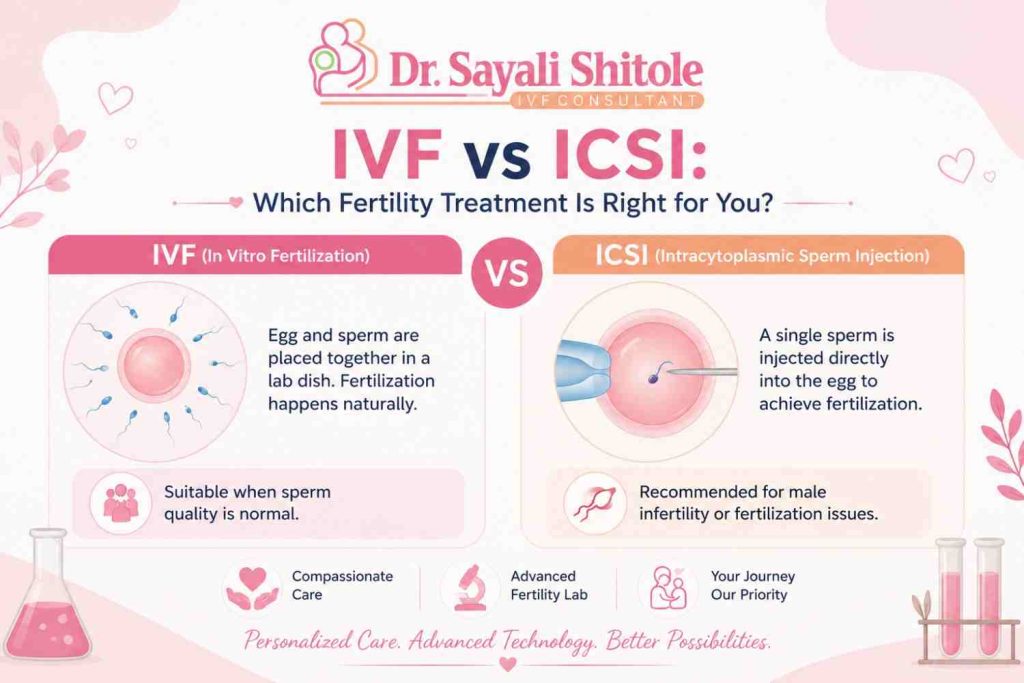
Choosing between IVF and ICSI is a common question among couples planning fertility treatment. Both procedures are used as part of assisted reproductive technology (ART), but they differ in how fertilization takes place. Understanding the difference between IVF and ICSI can help couples make informed decisions about their fertility journey.
IVF and ICSI are fertility treatments that differ in how fertilization occurs. In conventional IVF, eggs and sperm are placed together in a laboratory dish, while ICSI involves injecting a single sperm directly into a mature egg. IVF may be suitable when sperm parameters are appropriate, whereas ICSI is often considered for male infertility or previous fertilization failure. The right treatment depends on individual fertility reports and medical evaluation.
If you are searching for IVF or ICSI which is better, the answer depends on several factors, including sperm quality, previous fertilization results, reproductive history and the findings of fertility investigations.
At Femcare Fertility, Dr. Sayali Chavan Shitole, IVF Specialist in Pune, Kalyani Nagar, evaluates individual fertility reports to help couples understand suitable treatment options.
What Is IVF?
In Vitro Fertilization (IVF) is a fertility treatment in which eggs are collected from the ovaries and combined with sperm in a laboratory. Fertilization takes place naturally within the laboratory culture environment, allowing sperm to fertilize the egg.
Once fertilization occurs, the resulting embryos are monitored for development. A suitable embryo may then be transferred into the uterus as part of the treatment cycle.
How Does IVF Work?
The IVF process generally includes:
- Ovarian stimulation: Medicines are prescribed to help the ovaries develop multiple follicles.
- Egg retrieval: Mature eggs are collected through a medical procedure.
- Fertilization: Eggs and sperm are placed together in a laboratory dish.
- Embryo development: Fertilized eggs are observed as they develop into embryos.
- Embryo transfer: An appropriate embryo is transferred into the uterus.
- Pregnancy testing: A pregnancy test is performed at the recommended time.
IVF may be considered for different infertility conditions, including blocked fallopian tubes, unexplained infertility, endometriosis-related infertility and certain other reproductive concerns.
What Is ICSI?
Intracytoplasmic Sperm Injection (ICSI) is a specialized fertilization technique performed during an IVF cycle. Instead of placing eggs and sperm together in a laboratory dish, an embryologist injects one selected sperm directly into a mature egg.
ICSI is commonly considered when male infertility factors may affect fertilization.
How Does ICSI Work?
The ICSI procedure generally involves:
- Collection of mature eggs through egg retrieval.
- Preparation and examination of sperm in the laboratory.
- Selection of an individual sperm.
- Injection of the selected sperm directly into a mature egg.
- Monitoring of fertilization and embryo development.
- Transfer of a suitable embryo into the uterus when appropriate.
ICSI is performed as part of IVF treatment. It is not a completely separate fertility treatment from IVF.
IVF vs ICSI: What Is the Difference?
Understanding the difference between IVF and ICSI can help couples discuss their treatment options with a fertility specialist.
| Feature | Conventional IVF | ICSI |
|---|---|---|
| Fertilization method | Eggs and sperm are placed together | One sperm is injected into an egg |
| Sperm involvement | Sperm fertilizes the egg naturally in the laboratory | Embryologist selects and injects sperm |
| Common indication | Many infertility conditions | Particularly male factor infertility |
| Severe sperm abnormalities | May not be suitable in certain cases | Often considered |
| Previous fertilization failure | ICSI may be considered in a subsequent cycle | May reduce the risk of repeated fertilization failure |
| Laboratory procedure | Conventional insemination | Specialized micromanipulation |
| Pregnancy outcome | Depends on multiple clinical factors | Depends on multiple clinical factors |
IVF or ICSI: Which Is Better?
There is no single answer to whether IVF or ICSI is better for every couple. Both methods can be appropriate depending on the underlying infertility diagnosis.
When Is Conventional IVF Preferred?
Conventional IVF may be considered when:
- Sperm count and motility are within suitable parameters.
- No significant male factor infertility has been identified.
- There is no history of failed fertilization with conventional IVF.
- Fertility investigations suggest conventional insemination is appropriate.
For couples without a clear male factor infertility indication, routine ICSI has not consistently demonstrated better live birth outcomes than conventional IVF.
When Is ICSI Recommended?
ICSI may be considered in situations such as:
- Severe male factor infertility.
- Low sperm count or significantly reduced sperm motility.
- Certain sperm abnormalities affecting fertilization.
- Previous failure or very low fertilization with conventional IVF.
- Use of surgically retrieved sperm.
- Selected situations involving frozen eggs or specific genetic testing requirements.
The decision to use ICSI should be based on clinical findings and the anticipated benefit for the individual treatment cycle.
Does ICSI Have a Higher Success Rate Than IVF?
One of the most frequently asked questions is whether ICSI has a higher IVF success rate.
ICSI can improve the likelihood of fertilization in selected cases, especially when sperm-related problems affect fertilization. However, a higher fertilization rate does not automatically mean a higher pregnancy or live birth rate.
In couples without significant male factor infertility, research has not consistently shown that routine ICSI improves pregnancy or live birth outcomes compared with conventional IVF.
Factors that influence IVF outcomes include:
- Female age.
- Ovarian reserve.
- Egg quality.
- Sperm quality.
- Embryo development.
- Uterine health.
- Previous fertility treatment history.
- Other individual medical factors.
Therefore, comparing IVF and ICSI success rates without considering the clinical circumstances may be misleading.
IVF vs ICSI Cost: Which Treatment Is More Expensive?
The cost of IVF and ICSI can vary between fertility centres and treatment plans.
ICSI generally involves an additional laboratory procedure, which may increase the overall treatment cost compared with conventional IVF.
The total cost may depend on:
- Fertility medications.
- Egg retrieval and laboratory procedures.
- ICSI charges, when applicable.
- Embryo freezing.
- Frozen embryo transfer.
- Additional investigations.
- Other clinically required procedures.
Couples should understand the complete treatment estimate before starting a fertility cycle.
Can ICSI Be Done Without Male Infertility?
Yes, ICSI can sometimes be considered in selected situations even when significant male infertility has not been identified.
For example, it may be considered following previous failed fertilization with conventional IVF or in certain laboratory-specific circumstances.
However, ICSI is not automatically necessary for every couple undergoing IVF. Its use should be guided by clinical evidence rather than the assumption that it is always more effective.
IVF or ICSI: Which Is Better for First-Time IVF Patients?
For couples undergoing their first IVF cycle, the treatment decision generally begins with an assessment of both partners.
A fertility specialist may review:
- Menstrual history and ovulation.
- Ovarian reserve investigations.
- Ultrasound findings.
- Fallopian tube history.
- Semen analysis.
- Previous pregnancies or miscarriages.
- Duration and causes of infertility.
If sperm parameters are suitable and there is no clear indication for ICSI, conventional IVF may be considered.
If male factor infertility is identified, ICSI may be recommended as part of the IVF treatment plan.
The appropriate method is determined after reviewing the clinical findings.
IVF and ICSI Consultation in Pune
Couples looking for an IVF specialist in Pune may benefit from a consultation that explains the available fertility treatment options, their differences and the factors affecting treatment outcomes.
Dr. Sayali Chavan Shitole is an IVF and fertility specialist practising at Femcare Fertility, Kalyani Nagar, Pune. Her clinical practice includes evaluation and management of infertility, IVF, ICSI and other fertility-related concerns.
During a fertility consultation, couples can discuss their reports, previous treatment history and questions about conventional IVF or ICSI.
Understanding the treatment process before beginning a cycle can help couples make informed decisions about their reproductive care.
Frequently Asked Questions
1. IVF or ICSI which is better?
Neither IVF nor ICSI is universally better. Conventional IVF may be suitable when sperm parameters are appropriate, while ICSI is commonly considered for male factor infertility or previous fertilization failure.
2. Is ICSI more successful than IVF?
ICSI may improve fertilization in selected cases, particularly male factor infertility. However, it does not guarantee pregnancy and does not consistently improve live birth rates in couples without a clear indication.
3. Is ICSI painful?
The ICSI procedure is performed in the embryology laboratory on collected eggs. Patients do not feel the sperm injection itself. Egg retrieval and other parts of the IVF cycle involve separate medical procedures and associated considerations.
4. Can IVF fail even with good sperm quality?
Yes. Fertilization and embryo development depend on several factors, including egg quality, sperm function and laboratory conditions. Suitable sperm parameters do not guarantee successful fertilization or pregnancy.
5. Is ICSI necessary for every IVF cycle?
No. ICSI is not routinely required for every IVF patient. The fertility specialist and embryology team determine whether conventional IVF or ICSI is appropriate based on the clinical indication.
6. How do I choose an IVF specialist in Pune?
Consider the specialist’s qualifications, reproductive medicine training, experience, communication, treatment approach and the availability of appropriate fertility investigations and laboratory services.
Conclusion
The choice between IVF and ICSI depends on the cause of infertility and the findings of fertility investigations. Conventional IVF allows sperm to fertilize an egg naturally in the laboratory, while ICSI involves injecting an individual sperm directly into a mature egg.
For couples wondering IVF or ICSI which is better, an individualized fertility assessment is an important first step.
Consult Dr. Sayali Chavan Shitole, IVF Specialist in Pune, Kalyani Nagar, at Femcare Fertility to discuss fertility investigations and understand whether conventional IVF or ICSI may be appropriate for your treatment plan.
Clinic: 1st Floor, Suman Business Park, Opd No 2 Femcare Fertility Office 102, Kalyani Nagar, Pune, Maharashtra 411014
Contact: 7972996874
Website: https://drsayalichavanivfdoctor.com/

Dr. Sayali Chavan - Shitole
Dr. Sayali Shitole IVF & Fertility Specialist in Pune is a reliable and among the IVF Clinic in Pune & IVF Centre in Pune. Dr. Sayali Shitole is equipped with all ultra-modern facilities IVF Clinic/IVF Centre and Test Tube Baby Centre in Pune.