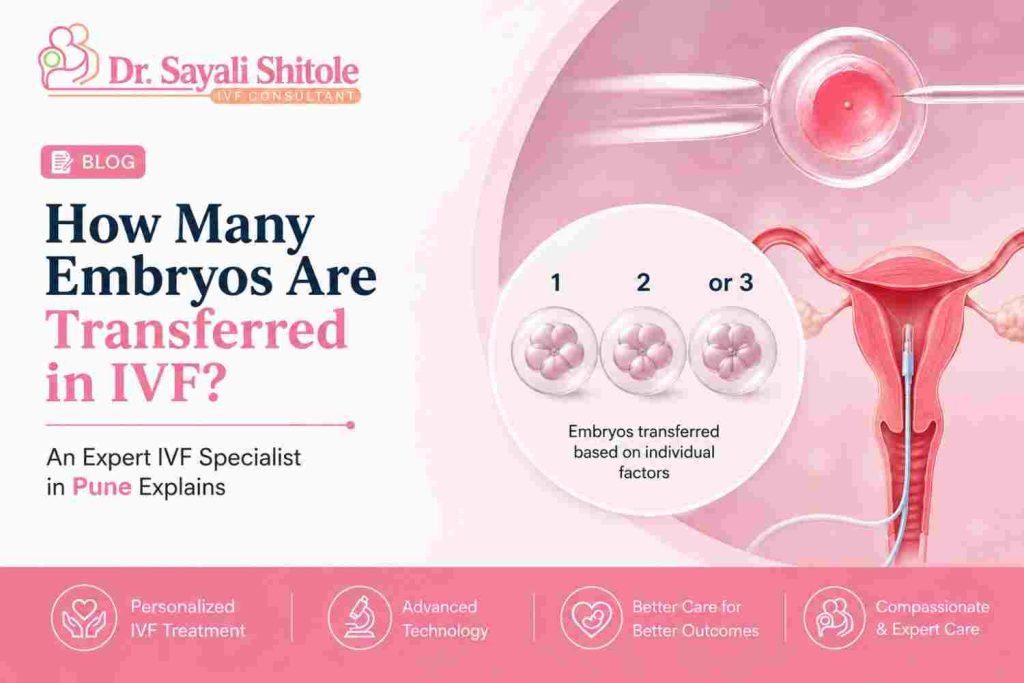
The number of embryos transferred in IVF usually ranges from one to two, decided by the patient’s age, embryo quality and IVF history. Most specialists, including Dr. Sayali Chavan Shitole in Pune, now prefer single embryo transfer for younger patients with good quality blastocysts to avoid multiple pregnancy risk.
Key Takeaways
- The number of embryos transferred in an IVF cycle depends on the woman’s age, embryo quality and previous IVF history, not one fixed number for every patient.
- Most fertility specialists Dr sayali Shitole , including those practising in Pune, now recommend single embryo transfer (SET) for patients with a good prognosis to lower the risk of a twin or triplet pregnancy.
- India’s ART (Regulation) Act, 2021 sets rules for how registered fertility clinics carry out embryo transfer, alongside the doctor’s clinical judgement.
- Blastocyst stage (Day 5) transfers usually allow the doctor to consider fewer embryos with a similar or better chance of pregnancy compared to Day 3 transfers.
- At Femcare Fertility in Kalyani Nagar, Dr. Sayali Chavan Shitole decides the embryo transfer number after reviewing age, embryo grading and the patient’s full medical history.
Importants Points
- Single embryo transfer (SET) is increasingly recommended worldwide to reduce twin and triplet pregnancy risk.
- Blastocyst (Day 5) embryos generally have a higher implantation potential per embryo than Day 3 embryos.
- Twin pregnancies from IVF carry a higher risk of preterm birth and low birth weight compared to singleton pregnancies.
- India’s ART (Regulation) Act, 2021 governs embryo transfer practices at registered fertility clinics.
At a Glance: Embryo Transfer Guidance by Patient Factor
| Patient Factor | Typical Guidance | Source |
| 1. Age under 35, good quality blastocyst | Single embryo transfer generally preferred | Industry estimate |
| 2. Age 35 to 40 | One to two embryos depending on embryo grading | Industry estimate |
| 3. Age above 40 or repeated IVF failure | Up to two embryos considered in select cases, doctor discretion | Industry estimate, confirm clinic protocol |
| 4. Day 5 blastocyst transfer | Often fewer embryos needed for a comparable chance of pregnancy | Industry estimate |
| 5. Two or more embryos transferred | Higher chance of twin pregnancy, with added risk of preterm birth and low birth weight | WHO, industry estimate |
Advantages of Embryo Transfer in IVF
Embryo transfer is the step that turns a fertilised egg grown in the lab into a real chance of pregnancy, and it offers several practical advantages over earlier fertility treatments once a couple has reached this stage of IVF.
- Uses the couple’s own embryo, created from their own eggs and sperm or from a donor source they have chosen, so the resulting pregnancy is genetically connected the way the couple intended
- Allows the embryologist to select the strongest, best graded embryo before transfer, which improves the odds of implantation compared to leaving conception to chance
- Makes it possible to freeze any extra good quality embryos through vitrification, giving the couple additional attempts at pregnancy from a single egg retrieval cycle
- Gives the doctor flexibility to choose between a fresh transfer or a frozen embryo transfer in a later, better prepared cycle, depending on what suits the patient’s hormone levels that month
- Allows genetic testing of the embryo (PGT) before transfer where medically indicated, which can reduce the chance of transferring an embryo with a known chromosomal issue
- Gives the patient and doctor a defined, plannable date for the procedure itself, which is far less invasive and shorter than the egg retrieval step that comes before it
These advantages are what make embryo transfer the step couples and doctors work toward throughout an IVF cycle, and they are also why the decision on how many embryos to transfer is treated with this much care.
What Decides How Many Embryos Are Transferred in an IVF Cycle
- There is no single correct number that applies to every IVF patient.
- The decision is made cycle by cycle, and it depends on a combination of medical factors rather than a patient’s personal preference alone.
- The woman’s age is one of the biggest factors, since embryo quality and implantation potential generally change with age.
- The grading of the embryo itself, meaning how well it has developed and how many cells it shows at the right stage, plays an equally important role.
- Whether the transfer happens on Day 3 or Day 5 of embryo development also changes the calculation, because a Day 5 blastocyst has already proven it can survive and divide correctly, which a Day 3 embryo has not yet shown.
- Finally, the patient’s history matters. Someone going through their first IVF cycle with no prior failures is usually approached differently from someone who has had two or three unsuccessful transfers in the past.
- Dr. Sayali Chavan Shitole reviews all of these factors together with the patient before recommending a number, rather than applying a fixed rule to every case.
Why Single Embryo Transfer Is Now the Preferred Approach
- For many years, transferring two or more embryos was common practice, partly because IVF success rates were lower and doctors wanted to improve the odds of at least one pregnancy per cycle.
- As embryo culture techniques, grading systems and freezing methods have improved, that approach has shifted. Single embryo transfer, often shortened to SET, has become the preferred option for patients with a good prognosis, meaning younger patients with high quality blastocysts and no major uterine or hormonal complications.
- The main reason is safety. A twin or triplet pregnancy carries a meaningfully higher risk of complications for both the mother and the babies, including preterm birth, low birth weight and a higher chance of needing a caesarean delivery.
- When a patient has more than one good quality embryo available, the remaining embryos can usually be frozen and used in a later cycle if needed, which means choosing SET does not necessarily reduce the overall chance of having a child from that embryo batch.
- It simply spreads the attempts across separate, safer pregnancies rather than combining them into one higher risk pregnancy.
When More Than One Embryo May Be Considered
- Single embryo transfer is the general direction fertility medicine is moving toward, but it is not the right choice for every patient in every cycle.
- A doctor may consider transferring two embryos in specific situations, such as an older patient where each embryo has a lower individual chance of implanting successfully, a patient who has had multiple previous IVF cycles fail with single embryo transfers, or a case where the available embryos are Day 3 rather than blastocyst stage and their individual implantation potential is harder to predict.
- Even in these situations, transferring two embryos remains a decision made jointly between the doctor and the patient after a clear discussion of the increased chance of a twin pregnancy and what that would mean for the patient specifically.
- It is not a default option, and it is not chosen simply because a patient requests it. The clinical reasoning has to support it.
Day 3 vs Day 5 (Blastocyst) Transfer and Embryo Numbers
- The day on which an embryo is transferred changes what the embryologist and the doctor already know about it.
- A Day 3 embryo is still relatively early in its development, and while it can be graded on cell number and symmetry, it has not yet reached the stage where weaker embryos naturally stop developing.
- A Day 5 embryo, called a blastocyst, has passed that filtering stage. Embryos that were not going to develop well have typically already stopped growing by Day 5, which means the ones that reach blastocyst stage tend to have a higher individual chance of implanting.
- This is one reason blastocyst culture has made single embryo transfer more practical.
- When a clinic can wait until Day 5 and select the strongest blastocyst, transferring just one embryo becomes a more confident decision than it would be at Day 3, when less information is available about each embryo’s true potential.
The Legal and Safety Framework Around Embryo Transfer in India
- Embryo transfer in India does not happen in a regulatory vacuum.
- The Assisted Reproductive Technology (Regulation) Act, 2021 governs how registered ART clinics and banks operate, including aspects of how embryo transfer is carried out and documented.
- The intent behind this kind of regulation, in line with similar rules in many other countries, is to protect patients from unnecessary multiple pregnancies and to standardise safety practices across clinics.
- A patient considering IVF in Pune should confirm that the clinic they choose is registered under the applicable regulations and that the doctor explains how these rules apply to their specific treatment plan.
How Dr. Sayali Chavan Shitole Approaches Embryo Transfer Decisions at Femcare Fertility
At Femcare Fertility in Kalyani Nagar, the number of embryos transferred is treated as a personalised clinical decision rather than a standard step applied to every patient. Dr. Sayali Chavan Shitole reviews the patient’s age, ovarian response, embryo grading from the embryology team and any previous IVF history before discussing options with the patient directly. Where a patient has multiple good quality blastocysts available, the conversation usually covers single embryo transfer as the starting recommendation, along with a clear explanation of what freezing the remaining embryos means for future attempts. Where the clinical picture is more complex, such as an older patient or a history of failed transfers, the discussion covers the specific reasons a different approach might be considered for that case.
Choosing an IVF Specialist in Pune for This Decision
Searches for how many embryos are transferred in IVF are common precisely because the honest answer is that it depends on the individual case, which generic information online cannot fully address. This is where consulting an IVF specialist in Pune directly makes a meaningful difference over relying on a general number found in a search result. Patients in Kalyani Nagar and the surrounding parts of Pune can get a transfer recommendation that is based on their own hormone levels, ultrasound findings and embryo grading, rather than an average figure that may not apply to their specific situation. A short consultation at Femcare Fertility is usually enough to explain what number of embryos makes sense for a particular cycle and why.
Frequently Asked Questions
1. Is it safe to transfer two embryos in IVF?
Transferring two embryos is a recognised clinical option in certain cases, but it does increase the chance of a twin pregnancy, which carries a higher risk of preterm birth and other complications compared to a single pregnancy. A fertility specialist will weigh this risk against the patient’s individual chances before recommending it.
2. Does transferring more embryos increase the chance of pregnancy?
Transferring more embryos can increase the chance that at least one implants in a single cycle, but it does not necessarily improve the overall chance of a healthy pregnancy, since it raises the risk of a twin pregnancy with its own complications. Many clinics now prefer single embryo transfer with the remaining embryos frozen for a future cycle if needed.
3. What is the ART Act rule on embryo transfer in India?
The Assisted Reproductive Technology (Regulation) Act, 2021 sets rules for how registered ART clinics in India carry out procedures including embryo transfer, as part of a broader framework to protect patient safety. Patients should ask their clinic directly how these regulations apply to their specific treatment.
4. Can I choose how many embryos are transferred?
The final decision is a shared one between the patient and the treating fertility specialist, but it is guided by clinical factors such as age, embryo quality and medical history rather than personal preference alone. A doctor will not recommend a number that carries unnecessary risk simply because a patient requests it.
5. What happens to embryos that are not transferred?
Good quality embryos that are not used in the current cycle can usually be frozen through a process called vitrification and stored for use in a future frozen embryo transfer cycle, subject to the clinic’s protocols and the patient’s consent.
6. Does age affect how many embryos are transferred?
Yes. Younger patients with high quality blastocysts are generally strong candidates for single embryo transfer, while older patients or those with a history of failed cycles may be assessed differently, since embryo implantation potential tends to change with age.
7. Is single embryo transfer as effective as transferring two embryos?
Across a full treatment plan that includes any frozen embryos from the same cycle, single embryo transfer can offer a comparable overall chance of pregnancy to transferring two embryos at once, while significantly lowering the risk of a twin pregnancy. The right approach still depends on the individual case.
IVF Cost at Femcare Fertility, Kalyani Nagar
Cost is one of the first practical questions most couples raise once they understand how embryo transfer and the wider IVF process in pune work. Femcare Fertility keeps this transparent so patients can plan ahead rather than being surprised mid cycle.
| Treatment | Estimated Cost | Notes |
| Consultation with Dr. Sayali Chavan Shitole | Rs. 500 | Per visit |
| IVF (In Vitro Fertilisation) | Rs. 1,00,000 to Rs. 2,50,000 | Per cycle, includes stimulation, retrieval and transfer |
| ICSI (Intracytoplasmic Sperm Injection) | Add Rs. 20,000 to Rs. 50,000 | Additional cost over a standard IVF cycle |
| IUI (Intrauterine Insemination) | Rs. 10,000 to Rs. 25,000 | Per cycle |
| Fertility Preservation (egg freezing) | Rs. 80,000 to Rs. 1,50,000 | Per cycle |
The exact cost for embryo transfer itself is included within the overall IVF cycle cost above rather than charged as a separate line item, since it is the final step of the same cycle that includes stimulation and egg retrieval. Couples considering a frozen embryo transfer in a later cycle, using embryos already frozen from a previous IVF attempt, should ask about the specific FET cost separately at consultation, as this is usually lower than a full fresh IVF cycle.
Book a Consultation With Dr. Sayali Chavan Shitole
If you are planning an IVF cycle and want a personalised recommendation on embryo transfer numbers based on your own reports
Book a consultation with Dr. Sayali Chavan Shitole at Femcare Fertility, Kalyani Nagar, Pune.

Dr. Sayali Chavan - Shitole
Dr. Sayali Shitole Best IVF & Fertility Specialist in Pune is a reliable and among the Best IVF Clinic in Pune & IVF Centre in Pune. Dr. Sayali Shitole is equipped with all ultra-modern facilities IVF Clinic/IVF Centre and Test Tube Baby Centre in Pune.