Real IVF Success Stories Pune Moms: Hope and Data
| Key Takeaways IVF success rates in Pune range from 45-55% per cycle for women under 35, based on ICMR 2024 data.Cumulative success rates over 2-3 IVF cycles reach 60-70% for appropriately selected patients.PCOS, blocked tubes, male infertility and unexplained infertility are the four most common diagnoses in Pune IVF success cases.PGT significantly improved outcomes for couples in Pune with recurrent implantation failure or advanced maternal age.Emotional resilience, strong partner support and clear communication with the treating doctor are factors in every success story.Women who failed 2-3 IUI cycles before IVF achieved pregnancy more quickly once they escalated to IVF.Donor egg IVF in Pune has delivered success rates of 55-65%, giving hope to women with poor ovarian reserve. |
| Quick Facts IVF success rate under 35 in Pune: 45-55% per cycle (ICMR 2024) Cumulative success 2-3 cycles: 60-70% Donor egg IVF success Pune: 55-65% per transfer Most common diagnoses in IVF success: PCOS, male factor, tubal factor, unexplained Average cycles to success in Pune: 1.5-2 cycles IVF with PGT implantation improvement: Approx 15-20% |
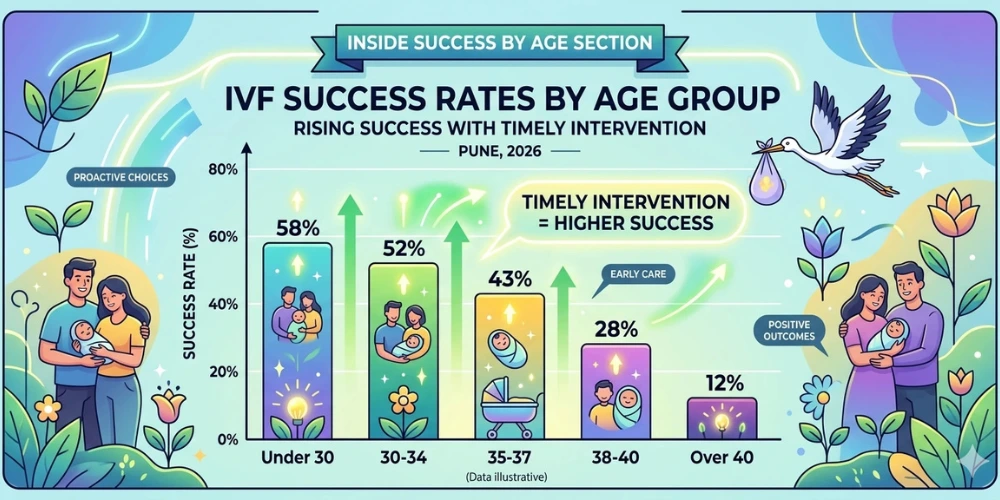
IVF Success Statistics Pune 2025-2026
| Patient Category | Success Rate Per Cycle | Notes | Source |
| Women under 35 | 45-55% | Best outcomes with own eggs | ICMR 2024 |
| Women 35-37 | 38-42% | PGT advised from 38+ | ICMR 2024 |
| Women 38-40 | 25-32% | Consider PGT strongly | PubMed 2023 |
| Women above 40 | 12-18% own eggs | Donor egg IVF advised | Industry estimate |
| Donor egg IVF (any age) | 55-65% | Vitrified donor eggs | ICMR 2024 |
| PCOS with own eggs | 45-55% with PCOS protocol | Careful OHSS monitoring needed | Industry estimate |
| Male factor + ICSI | 40-55% | Depends on female age | ICMR 2024 |
Story 1: PCOS, Two Failed IUI Cycles and a First IVF Success
Meera 29, from Wakad, had been diagnosed with PCOS at 22. Her periods were irregular. Ovulation induction with letrozole produced one or two follicles per cycle, but two IUI cycles failed. Her AMH was elevated (typical for PCOS) at 4.8 ng/mL, indicating good ovarian reserve.
Her first IVF cycle was adjusted for PCOS: a lower starting gonadotropin dose, more frequent monitoring and a freeze-all strategy to reduce OHSS risk. Twelve eggs were retrieved, 8 fertilised normally and 3 blastocysts were vitrified. A frozen embryo transfer 6 weeks later resulted in a positive beta HCG. She delivered a healthy baby girl the following year.
What made the difference? The IVF protocol was specifically adapted for PCOS. The freeze-all approach allowed her endometrium to recover from stimulation before transfer. Her partner’s complete support throughout the process was also a significant factor in her resilience.
Story 2: Severe Male Factor Infertility and ICSI Success at 37
Priya 34, and her husband Arun (name changed), 37, had been trying for 3 years. Arun’s semen analysis showed severe oligoasthenoteratospermia: count of 2 million per mL, motility of 15% and morphology of 1%. Standard IUI was not feasible with such parameters.
Their doctor recommended ICSI directly. Priya had normal investigations and a good AMH of 2.4 ng/mL. The cycle produced 9 eggs, 7 fertilised via ICSI and 4 blastocysts were formed. Two were transferred at Day 5. A twin pregnancy was confirmed at the 6-week scan. Both babies were born healthy at 36 weeks via planned caesarean section.
Their IVF journey took 4 months from first consultation to positive test. Going directly to ICSI rather than attempting IUI saved them an estimated 12-18 months of failed treatment cycles.
Story 3: Blocked Tubes, 40 Years Old and Donor Egg IVF
Sunita, 40, had both tubes blocked due to a previous pelvic infection. Her AMH was 0.3 ng/mL, indicating very low ovarian reserve. Her gynaecologist recommended donor egg IVF after two cycles with her own eggs produced only one egg each time, neither of which fertilised.
With a 26-year-old anonymous donor’s eggs, the IVF cycle produced 10 mature eggs, 8 fertilised normally and 5 blastocysts were frozen. A single blastocyst transfer was done. Sunita is today the mother of a 2-year-old son. Her donor was anonymous and tested to all ICMR ART Act 2021 standards.
Donor egg IVF carried an emotional weight: accepting that the child would not be genetically hers. The counselling sessions she attended helped her and her husband reach peace with this decision before starting treatment. She describes it as the best decision they ever made.
Story 4: Unexplained Infertility, Three IUI Failures and IVF Success
Deepa 32, from Koregaon Park, had perfect investigations on paper. Regular cycles, normal tubes, normal AMH, normal semen analysis. Three IUI cycles produced no pregnancy. She was diagnosed with unexplained infertility.
Unexplained infertility can be frustrating because there is no single cause to ‘fix.’ But IVF gives direct information about fertilisation and embryo quality that no pre-IVF investigation can provide. Deepa’s IVF cycle revealed that her embryos were consistently poor quality at Day 3 but developed into good blastocysts by Day 5. A Day 5 single blastocyst transfer resulted in a successful pregnancy. She now has a 3-year-old daughter.
This case illustrates why unexplained infertility is not the same as ‘nothing wrong.’ The IVF lab revealed the specific issue (poor early development requiring extended culture) and allowed it to be addressed within the same cycle.
What These IVF Success Stories Have in Common
Looking at hundreds of IVF successes at Pune clinics, certain patterns emerge. Couples who started their fertility investigation promptly, rather than waiting years for natural conception, had significantly better outcomes. Those who chose a clinic with a strong embryology lab produced more blastocysts available for selection and freezing.
Every successful patient received a protocol tailored to their specific diagnosis. There was no single universal IVF approach. PCOS patients needed PCOS protocols. Poor responders needed different stimulation than high responders. Older patients benefited from PGT. Personalisation of care is inseparable from IVF success.
IVF Success in Pune: The Local Picture
Pune’s fertility landscape has strengthened considerably over the past decade. Clinics in Kalyani Nagar, Baner and Wakad now have time-lapse incubators, vitrification capability and trained embryologists that match outcomes at metro centres in Mumbai and Delhi. Couples in Hinjewadi and Pimpri Chinchwad no longer need to travel to Mumbai for high-quality IVF care.
Femcare Fertility in Kalyani Nagar, where Dr. Sayali Shitole Chavan practises, has contributed to Pune’s growing IVF success story. With 15 years of experience including a Fellowship in Reproductive Medicine, Dr. Sayali’s personalised approach to diagnosis and protocol design is reflected in her clinic’s outcomes.
Contact Us - Best Fertility Physician and IVF Doctor in Pune
Frequently Asked Questions
Q: Are IVF success stories on websites real?
Anonymised success stories shared by fertility clinics are based on real patient experiences. They are edited for privacy but represent genuine cases. The most useful thing to look for is whether the clinic shares its own success rate data by age group, not just individual stories. Ask your clinic for its documented outcomes.
Q: What is the success rate of IVF at the first attempt in Pune?
For women under 35 at Pune’s better-equipped clinics, first-cycle IVF success rates (live birth) are approximately 45-55%. Success rates decline with age. Two to three cycles give cumulative rates of 60-70% for appropriate candidates. Not all couples succeed on the first cycle, and a plan for subsequent cycles is part of realistic expectation-setting.
Q: Does diet and lifestyle really affect IVF outcomes?
Yes, measurably. Couples who undertook 2-3 months of lifestyle preparation including dietary improvements, stopping alcohol, weight optimisation and stress management before IVF showed improved stimulation response and embryo quality in multiple studies. This preparation isn’t a guarantee but gives the treatment the best biological starting point.
Q: My doctor suggested donor eggs. Does that mean IVF with my own eggs will definitely fail?
A: Not necessarily. The recommendation for donor eggs is based on clinical indicators like very low AMH, advanced age and poor previous response. Your doctor is advising the path most likely to succeed. Many couples try one cycle with own eggs before moving to donation. Have a candid conversation with your specialist about the specific data behind the recommendation.
Q: How do I find a reliable IVF clinic in Pune with real success rates?
A: Ask any clinic you consider for their own IVF success rate by age group (live birth rate, not clinical pregnancy rate). Check if the clinic is registered with ICMR’s National ART Registry. Visit the clinic in person to assess the embryology lab and meet the team. Word of mouth from former patients, not just testimonials on the clinic website, is also valuable.
Dr. Sayali Chavan - Shitole
Dr. Sayali Shitole Best IVF & Fertility Specialist in Pune is a reliable and among the Best IVF Clinic in Pune & IVF Centre in Pune. Dr. Sayali Shitole is equipped with all ultra-modern facilities IVF Clinic/IVF Centre and Test Tube Baby Centre in Pune.
- Dr. Sayali Chavan - Shitole
- Dr. Sayali Chavan - Shitole
- Dr. Sayali Chavan - Shitole
- Dr. Sayali Chavan - Shitole