| Key Takeaways Recurrent pregnancy loss (RPL) is defined as two or more consecutive pregnancy losses before 20 weeks.RPL affects approximately 1-2% of couples trying to conceive, with 50-60% of losses due to chromosomal abnormalities.Antiphospholipid syndrome is found in 10-15% of RPL cases and is highly treatable with aspirin and heparin.According to ICMR, a structured RPL investigation panel identifies a cause in approximately 50-60% of couples.PGT (Preimplantation Genetic Testing) with IVF reduces chromosomally abnormal embryo transfers significantly.Unexplained RPL, where investigations are normal, still carries a 65-75% live birth rate in subsequent pregnancies.Emotional support and counselling are a clinical component of RPL management, not an optional extra. |
Recurrent Miscarriage Statistics 2025-2026 Pune
| Metric | Data Point | Source |
| RPL prevalence worldwide | 1-2% of couples | WHO 2022 |
| Chromosomal cause in first trimester loss | 50-60% | ICMR 2024 |
| Uterine abnormality in RPL | 10-15% | Industry estimate |
| APS identified in RPL | 10-15% | PubMed 2023 |
| Thyroid disorder in RPL | 5-10% | ICMR 2024 |
| Unexplained RPL proportion | 40-50% after full workup | Industry estimate |
| Live birth rate next pregnancy after RPL | 65-75% unexplained, higher with treatment | PubMed 2023 |
What Is Recurrent Miscarriage and When Should You Seek Help?
A single miscarriage is unfortunately common, affecting approximately 10-15% of recognised pregnancies. Most are caused by a chromosomal abnormality in that particular embryo, are not predictive of future losses and require no investigation. Recurrent pregnancy loss is different.
RPL is formally defined as two or more consecutive pregnancy losses. At this point, investigation is warranted. The chances of a subsequent loss increase with each miscarriage: approximately 25% after two, 30% after three. This is when a systematic evaluation finds causes that are specific to that couple and often treatable.
Don’t wait for a third loss. Most international guidelines including those from ICMR now recommend investigation after two consecutive losses, particularly in women over 35.
Common Causes of Recurrent Miscarriage: What the Evidence Shows
| Cause Category | Specific Causes | Prevalence in RPL | Treatable? |
| Chromosomal | Embryo aneuploidy, parental translocation | 50-60% of losses | PGT-A for embryo selection |
| Uterine factors | Septum, polyps, fibroids, adhesions | 10-15% | Yes, via hysteroscopy or surgery |
| Immunological | Antiphospholipid syndrome (APS) | 10-15% | Yes, aspirin + heparin |
| Endocrine | Thyroid disorders, uncontrolled diabetes | 5-10% | Yes, hormone therapy |
| Thrombophilia | Factor V Leiden, Protein S/C deficiency | 2-5% | Anticoagulation therapy |
| Male factor | Sperm DNA fragmentation | 5-10% | Antioxidants, ICSI |
| Unexplained | Normal investigations | 40-50% | Supportive care, PGT |
The RPL Investigation Panel in Pune
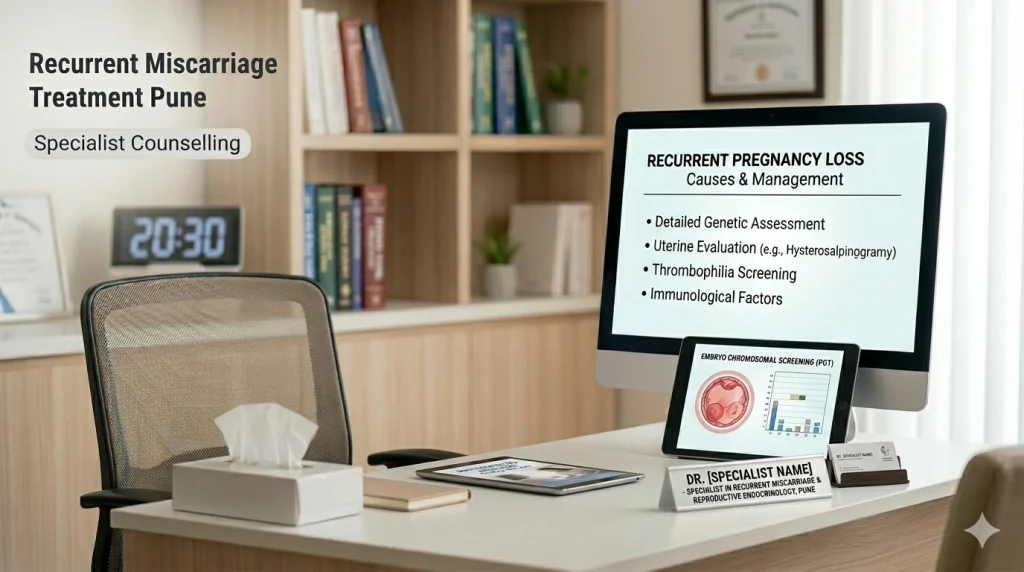
A complete RPL workup evaluates both partners and tests multiple systems simultaneously. For women, the panel includes antiphospholipid antibodies (anticardiolipin and anti-beta2 glycoprotein), lupus anticoagulant, thrombophilia screen (factor V Leiden, prothrombin gene mutation, protein S and C, antithrombin), thyroid function (TSH, anti-TPO), a uterine cavity assessment (hysteroscopy or saline sonography), karyotyping (chromosomal analysis of both partners) and if available, PGT on embryos from future IVF cycles.
The male partner needs sperm DNA fragmentation testing in addition to a standard semen analysis. High DNA fragmentation is associated with early miscarriage even when the semen analysis is otherwise normal.
The full panel costs INR 8,000 to INR 20,000 in Pune depending on which tests are needed. Your doctor will guide which tests are most relevant based on your miscarriage history.
Antiphospholipid Syndrome: The Most Important Treatable Cause
Antiphospholipid syndrome (APS) is an autoimmune condition where antibodies cause blood clots in the placental circulation, cutting off foetal blood supply. It accounts for 10-15% of RPL cases. The diagnosis requires the antibodies to be positive on two tests at least 12 weeks apart.
Treatment with low-dose aspirin (75mg daily from conception) and low-molecular-weight heparin (once a positive pregnancy test is confirmed) reduces the miscarriage rate in APS from approximately 90% untreated to 25-30%. This is one of the most effective interventions in reproductive medicine.
Emotional Support in Recurrent Miscarriage Care
Each miscarriage brings grief that compounds. By the third loss, couples are often exhausted, distrustful of their bodies and deeply anxious about attempting another pregnancy. The fear of joy, which psychologists describe as not allowing yourself to feel happiness about a new pregnancy in case it ends, is nearly universal in the RPL community.
Dr. Sayali Shitole Chavan’s approach to RPL includes formal psychological support as part of the care plan. Referral to a fertility-aware counsellor, online peer support groups and structured check-ins during a subsequent pregnancy are all part of managing RPL comprehensively. You’re not imagining how hard this is. It is that hard.
RPL Treatment and the Role of IVF with PGT
For couples with RPL where chromosomal causes are suspected or confirmed, IVF with Preimplantation Genetic Testing for Aneuploidy (PGT-A) allows embryos to be screened before transfer. Only chromosomally normal embryos are transferred, reducing the risk of miscarriage from aneuploidy significantly.
PGT-A is particularly valuable for women over 38, couples with a known chromosomal translocation in either partner and those with multiple consecutive losses after normal parental karyotyping. It adds INR 40,000-70,000 to an IVF cycle but substantially reduces the emotional and physical burden of repeated miscarriage.
RPL Management in Pune: Local Perspective
Pune has RPL specialists with training in both reproductive medicine and clinical immunology, which is the combination needed for comprehensive RPL care. Femcare Fertility in Kalyani Nagar, where Dr. Sayali Shitole Chavan practises, provides a structured RPL investigation pathway that can be completed within 3-4 weeks.
Couples from Kothrud, Baner, Wakad and Pimpri Chinchwad travel to Kalyani Nagar specifically for RPL consultations. Dr. Sayali’s Fellowship in Reproductive Medicine includes specific training in pregnancy loss management, which not all gynaecologists receive.
Frequently Asked Questions
Q: How many miscarriages before I should see a specialist in Pune?
See a specialist after two consecutive miscarriages. There is no clinical benefit in waiting for a third loss. For women over 35, investigation after two losses is particularly important given the higher baseline rate of chromosomal embryo abnormalities with advancing age. Don’t delay this step.
Q: Can stress cause recurrent miscarriage?
Stress alone is very unlikely to cause recurrent miscarriage. The primary causes are chromosomal, anatomical, immunological and endocrine. However, chronic severe stress raises cortisol, which can affect immune function and progesterone levels. Managing stress during a subsequent pregnancy is supportive but not a replacement for identifying and treating the underlying cause.
Q: Is there a cure for recurrent miscarriage?
For identified causes like APS, uterine abnormalities or thyroid disorders, treatment is highly effective and can normalise miscarriage risk. For unexplained RPL, supportive care in early pregnancy including progesterone supplementation, frequent scans and psychological support is associated with 65-75% live birth rates. There is rarely ‘nothing to do’ with RPL.
Q: Does PGT guarantee no miscarriage after IVF?
PGT-A significantly reduces miscarriage risk by selecting chromosomally normal embryos but does not eliminate all risk. Even chromosomally normal embryos can fail to implant or miscarry due to other causes. PGT is a powerful tool that reduces recurrence risk, not a guarantee of success.
Q: We’ve had two miscarriages. When can we try again?
Physically, you can try again once investigations are underway and your cycle has returned to normal, usually within 1-3 months of a miscarriage. Emotionally, the timeline varies. Many couples benefit from a brief pause to process the loss, complete investigations and start any indicated treatment before attempting again. Your doctor will advise based on your specific situation.
Conclusion
Recurrent miscarriage treatment in Pune has moved well beyond ‘just try again.’ A structured investigation panel identifies a cause in the majority of couples, and for those with identifiable causes, treatment is often highly effective. Even for unexplained RPL, dedicated specialist support significantly improves the chance of a successful pregnancy.
Dr. Sayali Shitole Chavan at Femcare Fertility, Kalyani Nagar, manages RPL with the clinical rigour it deserves and the compassion it demands. Her approach integrates investigation, treatment and emotional support from day one.
If you’ve experienced two or more pregnancy losses, book a consultation now at drsayalichavanivfdoctor.com. You deserve answers.

Dr. Sayali Chavan - Shitole
Dr. Sayali Shitole Best IVF & Fertility Specialist in Pune is a reliable and among the Best IVF Clinic in Pune & IVF Centre in Pune. Dr. Sayali Shitole is equipped with all ultra-modern facilities IVF Clinic/IVF Centre and Test Tube Baby Centre in Pune.